How Much Does Video Production Cost? What Actually Drives the Price
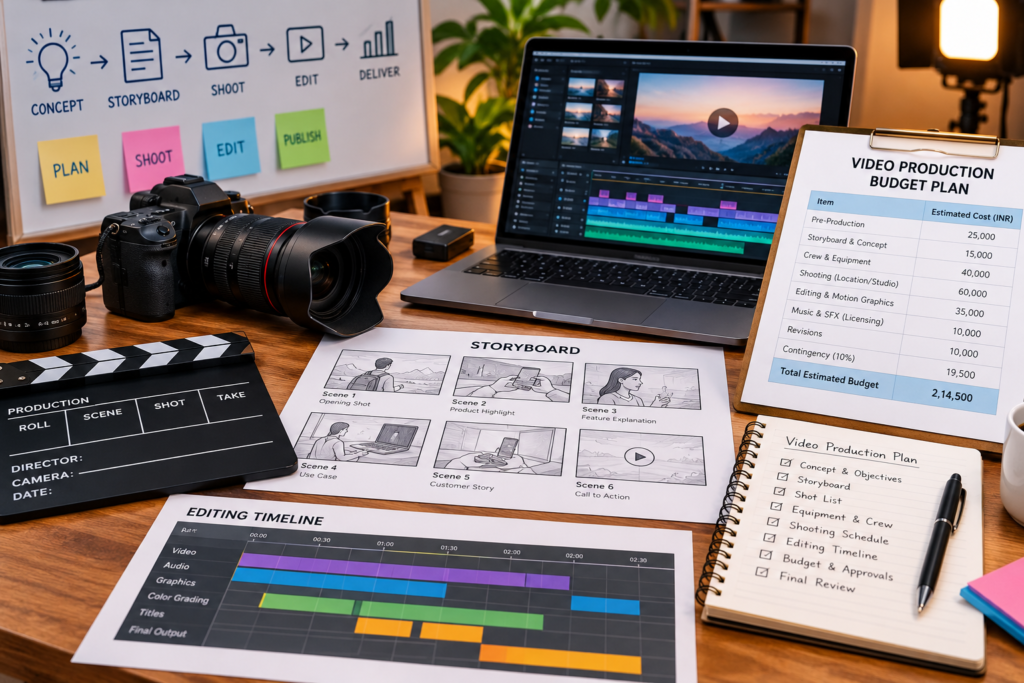
“How much does a video cost?” is one of the most common questions businesses ask, and one of the hardest to answer in a single number. A simple talking-head clip shot on location and a fully animated brand film can both be called “a video,” yet they involve completely different people, tools, and time.
This guide explains what you’re really paying for, how video production is priced, what affects the total, and how to plan a budget without getting caught out by surprises. It’s written for business owners and marketing teams who need to brief, compare, and approve video work.
Why Published Video Costs Vary So Much
Search for video production costs in India and you’ll find guides quoting anything from a few thousand rupees for a basic social clip to several lakhs, or far more, for a brand film. Different agencies publish very different ranges for similar-sounding projects, and many guides are written by agencies selling the service.
One independent data point: Clutch’s 2026 video production pricing guide, based on agency listings and reviews, puts typical agency hourly rates in India well below the US figure (Clutch). That kind of benchmark is useful for context, but an hourly rate says little about what a finished video costs, because the hours depend entirely on the scope.
So rather than quote a figure that could mislead you, this article focuses on what moves the price and how to get a quote you can compare fairly.
The Three Stages of Video Production
Every video, live-action or animated, passes through three stages. Cost sits in all three.
1. Pre-production
Planning decides how smoothly everything else goes. It includes:
- Defining the goal, audience, and where the video will be used
- Concept and creative direction
- Scriptwriting
- Storyboards or shot lists
- Casting, location planning, and scheduling
- For animation, style frames and character or scene design
Skimping here usually costs more later. Unclear briefs lead to reshoots and revisions.
2. Production
This is the shoot (or, for animation, the creation of assets and animation). It includes:
- Crew: director, camera operator, lighting, sound, assistants
- Equipment: cameras, lenses, lighting, audio gear
- Location or studio hire
- Talent, such as actors, presenters, or voice artists
- Props, styling, wardrobe, and set design
- Travel and logistics
3. Post-production
After filming or animation comes the finishing work:
- Editing and sequencing
- Colour correction and grading
- Motion graphics and titles
- Sound design, mixing, and music
- Subtitles and captions
- Exporting multiple formats and lengths
Post-production often takes more time than people expect, particularly for animation, motion-heavy edits, and multi-version deliverables.
Key Factors That Affect Video Production Cost
Type of video
Different formats need different skills and time. A short creator-style clip needs far less than a scripted shoot with a crew, and an animated film with custom characters needs a different kind of effort again. (More on types below.)
Length and number of deliverables
Longer videos cost more, but not always proportionally. A single shoot can produce several cut-downs, such as a main film plus short social versions. Planning these upfront is usually cheaper than commissioning them separately later.
Live-action vs animation
Live-action cost is driven by crew, locations, talent, and shoot days. Animation cost is driven by design, illustration, rigging, animation time, and render time. Animation can be easier to update later, since changes to a script or product may only need edits to the files rather than a reshoot.
Production quality and complexity
Multiple locations, specialised lighting, drone footage, complex set builds, or heavy visual effects all push cost up. A single location with a simple setup keeps it down.
Script and creative development
A video that needs original concept development and scriptwriting costs more than one where you provide a finished script. Strong creative thinking is also what separates a forgettable video from a useful one, so it’s rarely worth cutting entirely.
Talent and voice
Professional actors, presenters, and voice artists carry fees that vary by experience and usage. Using your own team or customers can reduce cost, but only if the result stays on-brand and credible.
Music, licensing, and usage rights
Licensed music, stock footage, and usage terms add cost. Where and for how long a video will run, for example organic social versus paid ads versus television, can affect licensing fees for talent and music.
Revisions and approvals
Most quotes include a set number of revision rounds. Extra rounds, late scope changes, and slow approvals add time and cost. A clear brief and a single decision-maker help avoid this.
Timeline
Rush projects often cost more because they require extra crew, longer days, or priority scheduling.
Who produces it
Freelancers, small studios, and larger agencies price differently, and they offer different levels of strategy, project management, and accountability. The cheapest quote isn’t necessarily the best value, and the most expensive isn’t automatically the best fit.
Common Video Types and What Drives Their Cost
Instead of guessing exact numbers, it’s more useful to understand how video types compare and what each one costs you in effort.
| Video type | Relative cost | What mainly drives the price |
|---|---|---|
| Creator-style or UGC clips | Lower | Creator fees, scripting, number of variations, usage rights |
| Simple social reels and short edits | Lower to moderate | Editing time, motion graphics, number of cut-downs |
| Product demo and walkthrough videos | Moderate | Scripting, screen or product capture, voiceover, polish |
| Testimonials and interview-led videos | Moderate | Crew, locations, interview setup, editing |
| 2D explainer and motion graphics videos | Moderate to higher | Script, illustration and style, animation length and complexity |
| Brand films and campaign videos | Higher | Concept, crew size, locations, talent, post-production |
| 3D animation and product visualisation | Higher | Modelling, lighting, animation, render time |
This table shows relative positioning only. Actual cost always depends on scope.
Here’s how a few of these look in practice:
- Creator-style content. UGC videos are designed to feel native to social platforms and often feature a creator speaking to camera. They tend to need lighter production than a scripted shoot, which is why they suit brands that need a steady flow of ad and social content.
- Explainers. A 2D explainer video is a practical way to explain a service, process, or software product when you don’t need a live shoot. Costs depend on script length, illustration style, and how much custom animation is involved. A 3D explainer video adds modelling, lighting, and rendering, so it generally sits higher on the scale.
- Motion graphics. Animated text, icons, charts, and graphic sequences work well for data-led content, brand intros, and social ads. Motion graphics are often a good fit when your story is more about information than people.
- Product demos. Product demo videos show how a product or software works. Cost depends on how much capture, scripting, voiceover, and polish is needed.
How Video Production Is Priced
Agencies and freelancers typically use one of these models:
- Fixed project fee. A set price for a defined scope. It’s the easiest to budget but only works if the scope is clear.
- Per-day or per-hour rate. Common for shoots and editing. It’s flexible, but total cost depends on how long the work takes.
- Per-minute or per-second rate. More common in animation, where each finished second requires design and animation effort.
- Retainer or monthly package. Suited to brands that need regular content. It can lower the per-video cost, since planning, style, and workflow are already established.
Whichever model is used, ask what’s included and what isn’t. Two quotes can look similar while covering very different things.
Costs People Forget to Budget For
- Revisions beyond the included rounds
- Additional formats and aspect ratios, such as vertical, square, and widescreen versions
- Subtitles, captions, and translations
- Music and stock licensing
- Voiceover and talent usage fees
- Location permissions and permits
- Travel, accommodation, and logistics
- Storage, raw footage, and project files
- Distribution costs, such as paid media to put the video in front of people
That last point matters more than many people expect. A video that no one sees doesn’t help you. Budget for how the video will be promoted, whether through organic social media marketing or paid performance marketing.
How to Plan a Video Production Budget
Step 1: Define the goal
What should the video achieve: awareness, enquiries, product understanding, training, or sales? The goal affects the format, length, and how much you should invest.
Step 2: Decide where it will be used
A video for your website homepage, paid social ads, a sales presentation, and an event screen may all need different lengths, formats, and quality levels.
Step 3: Plan the full set of deliverables
List the main video plus any cut-downs, thumbnails, captions, and alternate versions before you ask for quotes. This avoids surprise add-ons later.
Step 4: Prepare a clear brief
A good brief covers your business, audience, goal, message, tone, references you like, usage plan, timeline, and budget range. The clearer it is, the more comparable your quotes will be.
Step 5: Request itemised quotes
Ask providers to break down pre-production, production, and post-production, and to state revision rounds, deliverables, and exclusions. This makes it far easier to compare.
Step 6: Keep a contingency
Hold back a modest portion of your budget for changes and unforeseen items rather than allocating every rupee upfront.
How to Get More From Your Video Budget
- Plan multiple videos at once. Shooting or producing several pieces together spreads fixed costs.
- Repurpose. Cut one main video into shorter clips, quotes, and social posts.
- Prepare thoroughly. A finished script, approved storyboard, and ready location save time on the day.
- Keep the scope focused. One clear message usually beats trying to say everything.
- Use what you already have. Customer testimonials, team footage, and product visuals can feed into video content when quality allows.
- Maintain brand consistency. Reusing your visual identity, colours, fonts, and templates reduces design effort and keeps videos recognisable. A consistent brand identity makes each new video faster to produce.
- Plan content, not single videos. A content strategy helps you decide which videos support which goals, so spending is directed at what matters.
Common Video Budget Mistakes
- Choosing only on price. Very low quotes can leave out things you’ll later need.
- Starting without a clear goal. Unfocused videos are hard to justify and hard to measure.
- Skipping the script. Rewriting during production is slow and expensive.
- Too many decision-makers. Conflicting feedback drives extra revisions.
- Not planning distribution. Production without promotion wastes the investment.
- Ignoring usage rights. Check talent, music, and footage licensing before publishing.
- Forgetting versions. Social platforms often need different shapes and lengths.
- Treating video as a one-off. Consistent video content usually performs better than isolated pieces.
Questions to Ask Before Hiring a Video Production Company
- What exactly is included in the quote?
- How many revision rounds are included, and what do extra rounds cost?
- Who owns the final video and source files?
- What formats and versions will be delivered?
- Are music, stock assets, and talent usage rights included?
- What is the timeline, and what happens if it slips?
- Can I see examples of similar work?
- Who will I be working with day to day?
- How will approvals work?
How Akkenna Can Help
Akkenna is a Coimbatore-based team working across branding, animation, creative content, and digital experience. That means video can be planned alongside your brand, website, and marketing rather than made in isolation. If you’re considering explainer, motion, UGC, or product demo videos, share your goals, audience, and where the video will be used, and we’ll help you work out the right format and scope. Talk to Akkenna for a quote based on your actual requirements.
FAQ
How much does video production cost in India? There’s no single figure. Costs range widely depending on video type, length, production quality, and who produces it. Published guides vary enormously, so the most reliable approach is to define your scope and request itemised quotes.
What affects the cost of a video the most? The type of video, its length and complexity, the number of deliverables, crew and talent involved, post-production needs, and how many revisions are required.
Is animation cheaper than live-action video? Not necessarily. Animation avoids crew, location, and talent costs, but it requires design and animation time. Which is cheaper depends on the style, length, and complexity.
Why do video production quotes differ so much? Quotes may cover different scopes, quality levels, deliverables, and revision terms. Comparing itemised quotes makes it easier to see what you’re actually paying for.
How can I reduce video production costs? Prepare a clear brief and script, keep the scope focused, plan multiple deliverables together, reuse brand assets, and repurpose a main video into shorter cuts.
How long does video production take? It depends on the type and complexity. Simple edits can be quick, while scripted shoots and animated films need time for planning, production, and revisions.
Do I need a video production company or can I use a freelancer? Both can work. Freelancers can suit smaller, defined jobs, while studios and agencies offer wider capabilities, project management, and strategy. Choose based on scope, risk, and the support you need.
What should be included in a video production quote? Pre-production, production, and post-production items, deliverables and formats, revision rounds, usage rights, timeline, payment terms, and exclusions.
