What Is the Golden Circle in Content Marketing? A Practical Guide
Most business content starts with the product. “We offer branding services.” “Our software has twelve features.” “We manufacture precision components.” It’s accurate, and it’s easy to ignore, because every competitor is saying something similar.
The Golden Circle is a simple framework that asks you to flip that order: start with why you exist, then explain how you do it, and only then talk about what you sell. This guide explains what the Golden Circle is, how it applies to content marketing, how to use it step by step, and where its limits are.
What Is the Golden Circle?
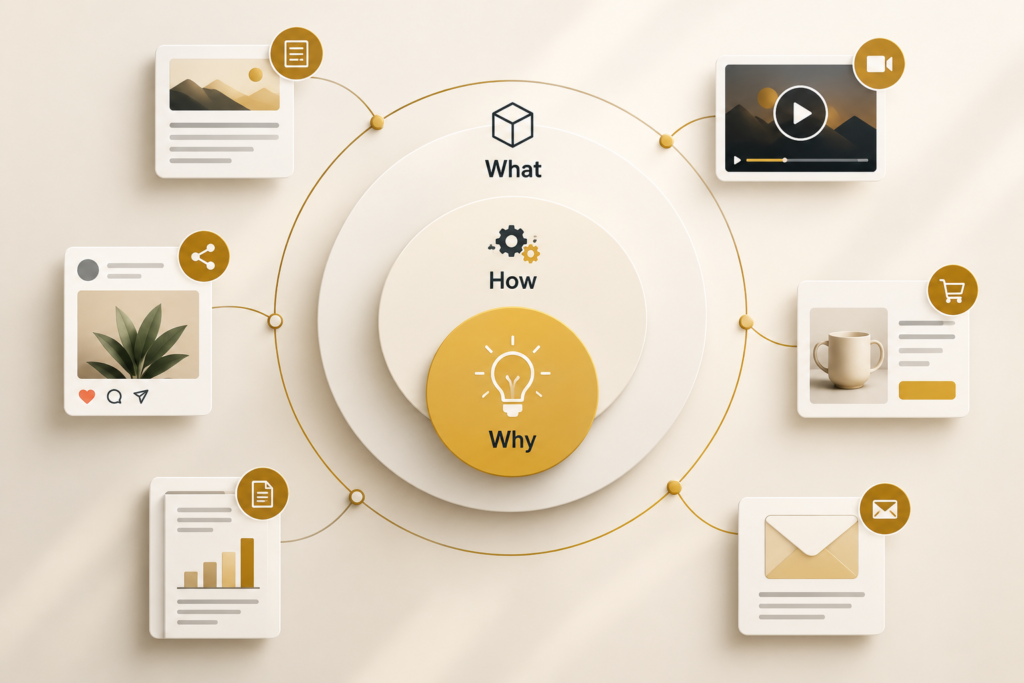
The Golden Circle is a communication model popularised by author Simon Sinek in his 2009 TEDx talk and his book Start With Why. It’s drawn as three concentric circles:
- Why (the centre): your purpose, cause, or belief. Why does the business exist beyond making money?
- How (the middle): the way you do it. The values, principles, and methods that set your approach apart.
- What (the outer ring): the products, services, or results you deliver.
Sinek’s argument is that most organisations communicate from the outside in, starting with what they sell, while the most compelling ones communicate from the inside out. People, he suggests, connect with beliefs and purpose first and then look for proof in the product.
A note of honesty: the framework is a useful way to think about messaging, not a scientific law. Sinek links it to how the brain processes decisions, but that explanation is a simplified analogy, and you shouldn’t treat it as settled research. Its real value is practical. It forces you to articulate what you stand for before you start producing content.
Why the Golden Circle Matters for Content Marketing
Content marketing works when it attracts the right people, builds trust, and helps them decide. The Golden Circle helps with all three.
It sharpens your message. Content built from a clear purpose has a consistent point of view instead of a scattered collection of topics.
It supports differentiation. Many competitors offer similar products. Few share the same reasons for existing or the same way of working. Why and how are harder to copy than what.
It builds connection. Purpose-led content helps people understand whether your brand aligns with their values, which matters most in considered purchases and long-term relationships.
It gives content a framework. When you’re stuck for ideas, the three circles offer three kinds of story to tell.
It connects strategy to execution. Your brand’s purpose and positioning don’t stay locked in a document. They show up in blog topics, videos, social posts, emails, and website pages. This is where brand strategy and content meet.
Breaking Down the Three Circles for Content
Why: the belief behind the brand
Your “why” isn’t a tagline or a goal like “be the best.” It’s the belief or cause that drives the business. Examples of the kind of question to ask:
- What problem in the world or in our industry bothers us?
- What do we believe should be different?
- Why did the founders start this?
- What do we want customers to be able to do, feel, or achieve?
In content, “why” shows up as stories, opinions, and values: founder stories, point-of-view articles, manifesto-style videos, and the “About” page.
How: the approach that makes you different
“How” is what you do differently in practice. It might be your process, principles, standards, or philosophy. Ask:
- What do we do that others don’t?
- What principles guide our decisions?
- How do we treat customers, quality, and craft?
In content, “how” shows up as behind-the-scenes posts, process explainers, case studies, comparisons, and educational content that demonstrates your approach.
What: the products and proof
“What” is the offer: products, services, features, pricing, and results. It’s still essential, since people need to know what they’re buying. In content, “what” shows up as product pages, demos, FAQs, specifications, testimonials, and case studies.
The key shift is order and emphasis. “What” doesn’t disappear. It just stops being the opening line.
Golden Circle in Content Marketing: A Simple Example
Take a fictional Coimbatore-based company that makes handloom cotton shirts.
Outside-in message (what-first): “We sell premium cotton shirts in 12 colours with free delivery.”
Inside-out message (why-first):
- Why: “We believe everyday clothes should be comfortable, honest, and made by people who are paid fairly.”
- How: “We work directly with handloom weavers, use natural dyes where possible, and make small batches.”
- What: “Our shirts are woven from cotton, available in 12 colours, with free delivery.”
The first version is a product description. The second gives a reader something to agree or disagree with, and it generates content: weaver stories, process videos, fabric care guides, and styling posts, all connected by one belief.
How to Use the Golden Circle in Your Content Marketing
Step 1: Define your why
Gather founders and key team members and answer: why does this business exist, and what do we believe? Write it in one or two plain sentences. Avoid generic claims such as “we’re passionate about quality.” Be specific enough that a competitor couldn’t use it unchanged.
Step 2: Define your how
List the two or three principles or practices that make your approach distinct. These should be things you actually do, not aspirations, so that your content can show them rather than just state them.
Step 3: Define your what
Clarify your core products and services and the outcomes customers get. Be concrete.
Step 4: Connect the circles to your audience
Purpose only matters if it matters to someone. Tie your why and how to the needs, problems, and values of your target audience. Content that starts with your belief but never reaches the customer’s concern will feel self-indulgent.
Step 5: Build content pillars from the circles
A practical way to structure a content plan:
| Circle | Content pillar | Example formats |
|---|---|---|
| Why | Purpose and point of view | Founder story, opinion articles, brand film, About page |
| How | Approach and expertise | Behind-the-scenes, process content, how-to guides, case studies |
| What | Offer and proof | Product pages, demos, FAQs, testimonials, comparisons |
Aim for a balance. A plan made entirely of “what” content reads like a catalogue. A plan made entirely of “why” content can feel vague and unproven.
Step 6: Match formats to the circles
- Why often suits video, long-form storytelling, and social posts that express values. A short 2D explainer video or brand story video can carry a purpose clearly without a live shoot.
- How suits educational blog posts, process videos, and social carousels.
- What suits product pages, product demo videos, comparison guides, and testimonials.
Step 7: Carry it across every touchpoint
Make sure your website, social media, emails, and sales material all reflect the same why, how, and what. This is where the visual and verbal system of your brand identity holds the message together, so that the brand sounds and looks consistent wherever people meet it.
Step 8: Plan, publish, and review
Turn the pillars into a calendar and track what resonates. A documented content strategy helps you decide which topics support which goals and keeps the three circles in balance over time.
Applying the Golden Circle to Different Channels
Website
Open your homepage with the problem you solve or the belief you hold, then show how you work, then present the offer. Your “About” page can tell the why in a human voice. Good website design and development makes sure the structure, hierarchy, and visuals support this order of story rather than burying it.
Blog
Mix thought-leadership posts (why), educational guides and case studies (how), and product or comparison pages (what). Each should link naturally to the others, so readers can move from belief to proof to purchase.
Social media
Use short posts to express values, show behind-the-scenes work, and share customer stories, alongside offers. Consistent social media marketing turns the same core message into recognisable, repeated touchpoints.
Video
Video is well suited to the “why” because voice, tone, and visuals can convey conviction quickly. Creator-style UGC videos can also show real customers explaining why your product matters to them, adding credibility to the story.
Use welcome sequences to share your story and beliefs, then follow with educational content and product updates.
Paid campaigns
Ads often lead with “what,” but your creative can still reflect your why and how. Testing purpose-led messages against product-led ones through performance marketing shows which resonates with your audience.
Common Mistakes When Using the Golden Circle
- Treating “why” as a slogan. A vague statement about excellence doesn’t differentiate you.
- Making up a purpose. If the why isn’t true in how the business operates, customers will notice.
- Ignoring the customer. Your why needs to connect to something the audience cares about.
- Dropping the “what” entirely. People still need clear information to buy.
- Using it only in the tagline. The framework should shape content across channels, not appear once on the homepage.
- Posting purpose content without proof. Pair belief with evidence, such as case studies, results, and testimonials.
- Being inconsistent. A message that changes each quarter weakens the brand.
- Expecting it to replace research. The Golden Circle is a messaging aid, not a substitute for audience research or testing.
Limitations of the Golden Circle
It’s worth being balanced about where the model has limits:
- It’s simple by design. Real positioning also involves audience, competition, pricing, and market context.
- Not every buying decision is purpose-driven. In some categories, price, convenience, or specifications drive choices more than belief.
- “Why” can become empty rhetoric. Without evidence, it reads as marketing language.
- The underlying science is debated. Treat Sinek’s brain analogy as an illustration rather than a proven mechanism.
Used as one tool alongside audience research, positioning, and testing, the framework is helpful. Used as a formula that guarantees results, it’s likely to disappoint.
A Quick Golden Circle Checklist
- Can you state your why in one or two specific sentences?
- Do your principles (how) describe what you actually do?
- Is your what clear, concrete, and easy to find?
- Does your why connect to your audience’s needs?
- Does your content plan include all three circles?
- Do your website, social media, and emails tell the same story?
- Do you back up beliefs with proof?
- Are you reviewing performance and adjusting?
How Akkenna Can Help
The Golden Circle works best when the thinking behind it is turned into consistent content, design, and digital experience. Akkenna works across strategy, creative content, and digital, so purpose and positioning can carry from brand strategy through to videos, social content, and your website. If your content describes what you sell but not why anyone should care, talk to Akkenna.
FAQ
What is the Golden Circle in content marketing? It’s a framework from Simon Sinek with three layers: Why (purpose), How (approach), and What (offer). In content marketing, it means leading with your beliefs and approach before describing your products, so your content connects with people before it sells.
Who created the Golden Circle? Author and speaker Simon Sinek popularised it in his 2009 TEDx talk and his book Start With Why.
What are the three parts of the Golden Circle? Why is your purpose or belief, How is the way you deliver on it, and What is the products, services, or results you offer.
How do I find my “why” for content marketing? Ask why the business exists, what problem or belief drives it, and what you want customers to achieve. Write it in specific language, and test whether it’s true in how the business actually operates.
Can the Golden Circle be used for B2B content? Yes. B2B buyers also respond to clear purpose, credible process, and proof. In B2B, “how” and “what” often carry more weight, with case studies and technical detail supporting the story.
Is the Golden Circle the same as brand positioning? Not exactly. The Golden Circle is a messaging framework. Positioning also covers audience, competitors, and the specific space you want to occupy in the market. They work best together.
Does the Golden Circle replace content strategy? No. It gives your content a purpose-led foundation, but you still need audience research, topic planning, channels, and measurement.
What are the criticisms of the Golden Circle? It oversimplifies how people make decisions, it can lead to vague purpose statements, and the scientific explanation behind it is debated. Use it as a practical guide rather than a rule.
