Fashion Content Marketing: How to Build a Brand People Follow, Not Just Scroll Past
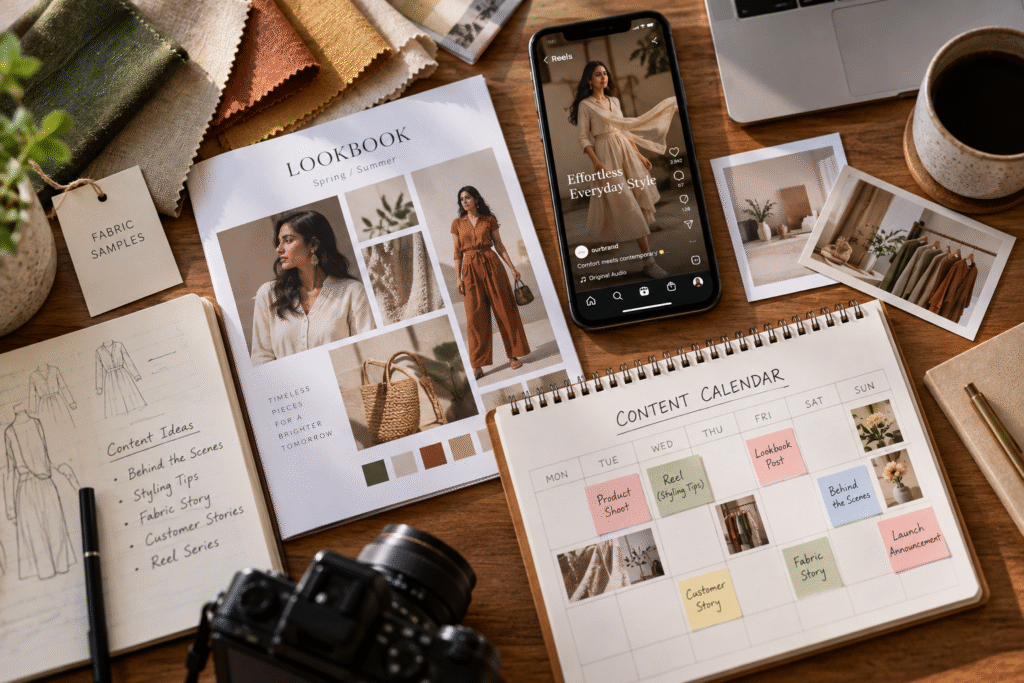
Most fashion brands don’t have a content shortage. They have a content direction problem.
The Instagram grid is full. The product shoots are done. A festive campaign goes out every season. Yet engagement is flat, product pages don’t convert the way the visuals suggest they should, and the brand looks much like every other label in its price range.
That gap is what fashion content marketing is meant to close. This guide covers what it actually involves, the content that tends to work for fashion and apparel businesses, how to plan it across channels, and how to measure it, written for founders and marketing teams rather than content specialists.
What Is Fashion Content Marketing?
Fashion content marketing is the practice of creating and distributing content that attracts, informs, and retains customers for a fashion business, without relying only on paid ads or discounts.
It includes lookbooks, styling guides, short-form video, product page copy, blog articles, email campaigns, behind-the-scenes content, and customer-created content. The common thread is that each piece gives the audience something beyond “buy this.”
Fashion content marketing is not the same as posting product photos. A product photo shows what you sell. Content marketing shows why it belongs in someone’s life, how to wear it, and what the brand stands for.
Why Fashion Is a Different Content Challenge
Fashion has traits that change how content should be planned:
- It’s visual first. Customers judge quality, fit, and mood before reading a word. Weak imagery undermines strong copy.
- It’s emotional and identity-driven. People buy clothing partly to express who they are, so content has to speak to identity, not just features.
- It’s seasonal. Collections, festivals, wedding seasons, and weather cycles create natural content peaks and long quiet stretches that need planning.
- Uncertainty is high. Online shoppers can’t touch fabric or try on fit, so content has to reduce doubt: sizing guidance, fabric detail, styling on real bodies, and honest product descriptions.
- Competition is crowded. Many labels sell similar silhouettes at similar prices. Content is often where differentiation actually shows up.
Start With Brand Strategy, Not a Content Calendar
Before posting schedules and formats, a fashion brand needs clear answers to a few questions:
- Who exactly is the customer, and what is she, he, or they looking for?
- What does the brand stand for beyond the clothes: craft, sustainability, occasion-wear, everyday comfort, regional heritage?
- How is the brand positioned against competitors: premium, accessible, designer-led, value-driven?
- What should the brand be known for in three years?
Content built without these answers tends to drift between trends. Content built on them has a consistent voice, look, and point of view, which is what makes people recognise a brand without seeing the logo. If this foundation is unclear, it’s worth working through Brand Strategy before investing heavily in production. Our earlier piece on [Brand Strategy vs Brand Identity: What’s the Difference?] explains how the two layers fit together.
Core Content Pillars for Fashion Brands
Rather than posting whatever feels timely, most fashion brands benefit from three to five repeatable pillars. These are examples, not a fixed formula:
1. Product and craft. Fabric, construction, process, and the people behind the work. Particularly useful for brands whose value lies in handloom, artisanal, or small-batch production.
2. Styling and use. How to wear a piece, how to combine it, and how it works across occasions. This directly supports purchase decisions and reduces returns driven by “I didn’t know how to style it.”
3. Inspiration and mood. Lookbooks, campaign imagery, and editorial storytelling that communicate the brand’s world.
4. Community and proof. Customer photos, reviews, real-body styling, and user-generated content. It builds trust in a way brand-produced content can’t.
5. Education. Size guides, fabric care, how to choose an outfit for an occasion, and what to look for in quality. This content supports both customers and search visibility.
Each pillar should serve a different stage of the customer journey: discovery, consideration, purchase, and repeat purchase.
Content Formats That Work for Fashion
Short-form video. Reels and Shorts suit fashion well: styling transitions, fabric movement, behind-the-scenes, and “one piece, three ways” formats. Quality lighting and movement matter more than elaborate production.
Lookbooks and campaign stories. A well-art-directed seasonal lookbook gives the brand a reference point everything else can follow.
Product page content. Often the most overlooked and highest-impact content a fashion store has. Clear fabric details, measurements, model height and size worn, care instructions, and styling suggestions do real conversion work.
Blog and editorial content. Articles such as “how to style a saree for different occasions” or “what to wear to a destination wedding” attract search traffic and build authority, particularly when written for questions customers actually ask.
Email and WhatsApp. For existing customers, new-arrival previews, styling edits, and restock alerts tend to perform better than generic discount blasts.
User-generated and influencer content. Real customers wearing real products carry credibility, and creator-style UGC videos are one way to produce it. Influencer partnerships work best when the creator’s audience and aesthetic genuinely match the brand, not just when follower counts are high.
Channels: Where Fashion Content Lives
Instagram remains central for discovery and brand mood. Treat the grid as a brand surface, not a dumping ground.
Pinterest works as a search engine for inspiration, particularly for occasion-wear, bridal, and home-adjacent fashion. Content has a longer shelf life than on most feeds.
YouTube suits longer styling content, fit explainers, and brand storytelling.
The website and blog are the owned channel everything else should lead back to. Social platforms change reach rules; your website doesn’t.
Email and WhatsApp are retention channels where relationships with existing customers are built.
Choose channels by where your audience actually spends time, not by trying to be everywhere.
Plan Content Around the Fashion Calendar
For brands selling in India, the calendar has natural content moments worth planning well in advance:
- Wedding season and festive periods such as Diwali, Eid, Onam, Pongal, and Durga Puja, depending on your market
- Seasonal shifts between summer cotton and winter layering
- Regional celebrations relevant to your customer base
- End-of-season and clearance periods
- New collection launches
Plan the content build-up before each peak, not during it. A festive campaign needs teasers, styling guides, gifting content, and last-order reminders, and most of that should be ready weeks before the occasion.
Between peaks, evergreen content (styling basics, fabric care, size guides) keeps the brand visible and gives search engines something to index.
SEO for Fashion Content
Search visibility is often treated as an afterthought in fashion, but customers do search for what they want: “cotton kurta sets for office,” “what to wear to a day wedding,” “how to measure for a blouse.”
Practical starting points:
- Write unique product descriptions rather than copying supplier text. Duplicate descriptions give search engines little reason to prefer your page.
- Use descriptive category page copy that helps both shoppers and search engines understand the range.
- Optimise image file names and alt text so products can surface in image search.
- Build informational articles around real customer questions and link them to relevant product categories.
- Keep site structure clear, so shoppers and crawlers can get from category to product easily.
Search-driven content takes longer to build than a campaign post, but it keeps working long after a seasonal push ends.
Keep the Brand Consistent Across Content and Website
A fashion brand can have great photography and still lose people if the website experience doesn’t match it. Typography, colour treatment, layout, tone of voice, and product page structure should feel like one brand across Instagram, email, and the store.
This is where branding and web experience meet. If your content builds a certain mood and the site feels like a generic template, the gap shows. We cover this in more depth in [Branding and Website Design: Why They Should Be Planned Together] and [From Brand Identity to Website: How a Brand Becomes a Digital Experience].
How to Measure Fashion Content Marketing
Different content has different jobs, so metrics should match. Examples:
| Goal | Useful indicators |
|---|---|
| Awareness | Reach, video views, follower growth, branded search |
| Engagement | Saves, shares, comments, time on page |
| Consideration | Product page views, add-to-wishlist, email sign-ups |
| Conversion | Purchases, conversion rate, revenue from content-led traffic |
| Retention | Repeat purchase rate, email and WhatsApp engagement |
| Search visibility | Organic traffic, rankings for target keywords |
A few cautions. Likes alone rarely show business impact. Saves and shares usually say more about whether content is genuinely useful. And last-click attribution can undervalue content that influences someone weeks before they buy, so look at the full path where possible.
Common Fashion Content Marketing Mistakes
- Posting product shots only. Without styling, context, or story, content gives people little reason to follow.
- Chasing every trend. Trend-jumping without a consistent brand point of view makes a label forgettable.
- Inconsistent visual quality. A mix of professional shoots and low-quality images weakens trust.
- Neglecting product pages. Strong social content that leads to thin product pages wastes the attention it earned.
- Ignoring sizing and fit content. Uncertainty about fit is a major barrier to online fashion purchases. Answer it directly.
- Relying on discounts as the main content. Constant offers train customers to wait for sales.
- Choosing influencers by follower count alone. Audience fit matters more than size.
- Treating content as campaign-only. Without evergreen content, visibility drops between launches.
- Not repurposing content. One shoot can produce reels, stills, email creative, blog visuals, and product page assets with planning.
- Disconnecting content from the website. If social content doesn’t lead anywhere coherent, the journey breaks.
A Practical Fashion Content Workflow
- Define positioning and audience. Who you serve and what you stand for.
- Set content pillars. Three to five themes that repeat.
- Plan the calendar. Map collections, festivals, and seasonal peaks.
- Plan production around shoots. Capture stills, video, behind-the-scenes, and product page assets together.
- Publish across chosen channels. Adapt formats for each, rather than posting identical content everywhere.
- Optimise owned channels. Product pages, blog, email flows, and site structure.
- Measure and refine. Review what content drives saves, traffic, and sales, and adjust.
Who Needs This Most?
New fashion labels need positioning and a consistent visual voice before scaling volume.
Established D2C brands often need stronger product page content, search visibility, and retention content to improve returns from existing traffic.
Boutiques and designers benefit from storytelling and community content that reflects the personal, crafted nature of the business.
Brands expanding to new markets need content adapted to different audiences, climates, occasions, and cultural contexts.
How Akkenna Can Help
Fashion content works best, particularly in Fashion & Lifestyle, when it’s connected to brand strategy, visual identity, and the website where customers eventually buy. Akkenna works across strategy, design, technology, and growth, which means content planning can sit alongside Brand Strategy, Brand Identity, Website Design & Development, UI/UX Design, Content Strategy, Social Media Marketing, Graphic Design, E-commerce Development, and Performance Marketing rather than being handled as a disconnected activity.
If your brand has good products but content that isn’t building recognition or sales, a content and brand review is a sensible place to start.
Build a Fashion Brand People Follow.
FAQ
What is fashion content marketing? It’s the planned creation and distribution of content, such as lookbooks, styling guides, video, blog articles, and email, that attracts and retains fashion customers by offering value beyond the product itself.
Why is content marketing important for fashion brands? Fashion is visual, emotional, and crowded. Content helps a brand communicate its point of view, reduce purchase uncertainty, and build recognition without depending entirely on discounts or paid ads.
What type of content works best for fashion brands? There’s no single winner. Short-form video, styling content, strong product pages, and customer-created content tend to be useful, but the right mix depends on the audience and channels.
Which social media platform is best for fashion marketing? Instagram is central for many fashion brands, with Pinterest and YouTube useful for inspiration and longer content. Choose based on where your target customers actually spend time.
How often should a fashion brand post? Consistency matters more than a fixed number. A sustainable schedule you can maintain at good quality is better than frequent posting that dilutes the brand.
Does SEO matter for fashion brands? Yes. Customers search for products, styling advice, and occasion-wear ideas. Unique product copy, clear category pages, and useful blog content help a brand show up in those searches.
How do you measure fashion content marketing results? Match metrics to goals: reach and views for awareness, saves and shares for engagement, product page behaviour for consideration, and sales and repeat purchases for conversion.
Should fashion brands work with influencers? It can work well when the creator’s audience and style genuinely fit the brand. Fit matters more than follower count, and results should be tracked like any other channel.
