How to Design Brand Guidelines: A Practical Guide for Growing Businesses
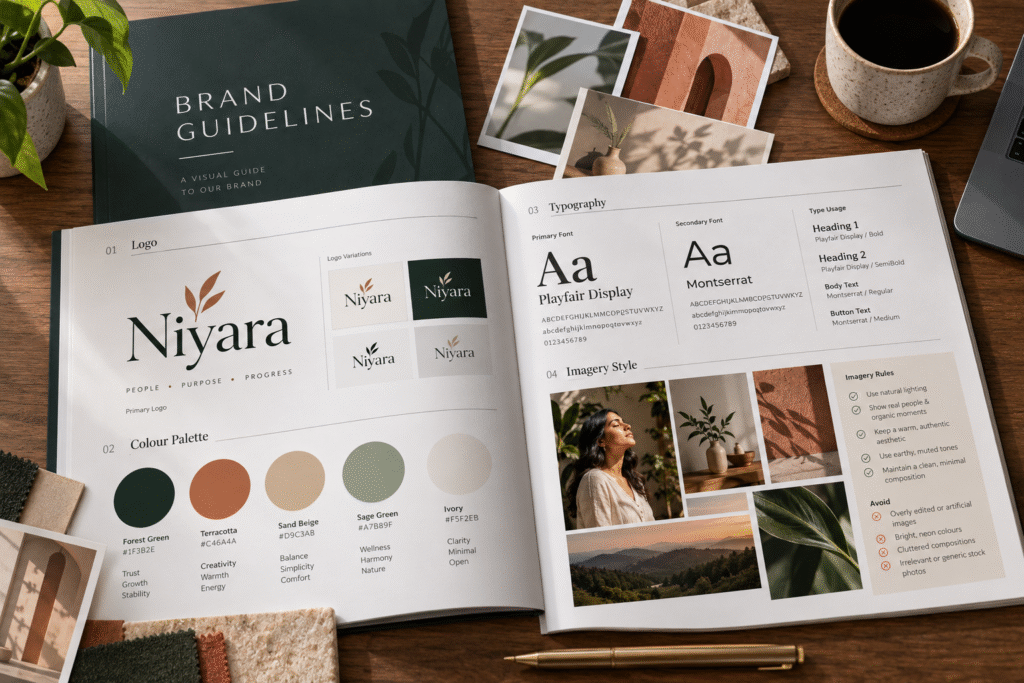
Most businesses discover they need brand guidelines the hard way. A new designer uses a slightly different blue. A sales deck sets the logo in a font nobody recognises. The website says one thing, the brochure says another, and nobody can say which one is right.
Brand guidelines exist to settle those questions before they come up. This guide explains what they are, what belongs in them, and how to design brand guidelines that people actually use, not a PDF that gets approved and then forgotten.
What Are Brand Guidelines?
Brand guidelines are a reference document that explains how a brand should look, sound, and behave, and how to apply it consistently across every channel.
They answer practical questions:
- Which logo version goes on a dark background?
- What are the exact brand colours, and which ones are for buttons versus backgrounds?
- Which fonts do we use for headlines and body text?
- What kind of photography fits the brand?
- How should we sound in an email, a social post, or an error message?
Good guidelines turn brand decisions into shared rules, so teams, freelancers, and vendors can produce work that looks and sounds like one company without asking for approval every time.
Brand Guidelines vs Brand Identity vs Brand Strategy
These terms are often mixed up, so it helps to separate them.
- Brand strategy defines what the brand stands for, who it serves, and how it’s positioned.
- Brand identity is the visual and verbal expression of that strategy: logo, colours, typography, imagery, and voice.
- Brand guidelines document the identity and explain how to apply it correctly.
Put simply, strategy gives direction, identity gives expression, and guidelines keep that expression consistent. We cover the first two in [Brand Strategy vs Brand Identity: What’s the Difference?]
Brand guidelines are sometimes called a brand book, brand manual, or style guide. The names overlap, and the distinction that matters is scope: a style guide may cover only visuals, while full brand guidelines also cover positioning and voice.
Why Brand Guidelines Matter
Without guidelines, consistency depends on memory and personal taste. With them:
- Work gets faster. Designers and marketers stop re-deciding basics.
- Onboarding is easier. New team members and agencies start from the same reference.
- Approvals are simpler. Feedback shifts from “I don’t like it” to “this doesn’t follow the guidelines.”
- The brand looks cohesive. Customers see one company across the website, social media, packaging, and sales material.
- Quality control scales. As more people touch the brand, a shared standard protects it.
Guidelines don’t create a brand. They protect and extend one that has already been defined.
Before You Design: Get the Foundations Right
Guidelines can only document decisions that exist. If positioning, audience, and personality are still unclear, the guidelines will be vague too.
Before you start, confirm:
- The brand’s positioning and target audience
- The brand personality and values
- A finished or near-final logo and visual identity
- The main places the brand will appear: website, social media, print, packaging, presentations, product interfaces
If the identity itself isn’t settled, start with Brand Strategy and Brand Identity, then document the result.
What to Include in Brand Guidelines
The right scope depends on the business. Here are the sections most guidelines cover.
1. Brand overview
A short summary of purpose, mission, values, audience, positioning, and personality. This section gives context to every rule that follows. Keep it brief: one or two pages is usually enough.
2. Logo usage
Show the primary logo and its variations: horizontal, stacked, icon-only, and one-colour versions. Then define:
- Clear space around the logo
- Minimum sizes for print and screen
- Approved colour versions for light and dark backgrounds
- Common misuse examples, such as stretching, recolouring, adding effects, or placing it on busy imagery
If your logo is still in development, our Logo Design service can build a mark that works across these contexts from the start.
3. Colour palette
Define primary, secondary, and neutral colours, and specify them in every format the brand needs:
- HEX and RGB for screens
- CMYK for print
- Pantone references where spot colours are used
Explain how colours should be used, not just what they are. For example: which colour leads, which supports, and which is reserved for calls to action.
Check contrast, too. The W3C Web Content Accessibility Guidelines set minimum contrast ratios for text, and guidelines are a good place to record which colour pairings meet them.
4. Typography
Name the typefaces, and set rules for how they are used:
- Headline, subheading, body, and caption styles
- Sizes, weights, and line spacing
- Fallback fonts for situations where brand fonts aren’t available, such as email or documents
- Licensing notes, so teams know whether a font can be used on the web or in apps
Typefaces should be tested in real digital interfaces, not only in brand presentations.
5. Imagery and photography
Describe the visual style: lighting, composition, colour treatment, subject matter, and what to avoid. Include example images showing the right and wrong direction. For brands that use illustration, video, or motion, add similar guidance.
6. Iconography and graphic elements
Document icon style, patterns, shapes, lines, and any recurring graphic devices. Specify how they are used and where they shouldn’t appear.
7. Brand voice and tone
Describe how the brand sounds, and give examples. A useful format is:
- Voice traits, such as clear, warm, and confident
- What each trait means in practice, and what it doesn’t mean
- Tone adjustments for different situations, like a product announcement versus an apology
- Sample headlines, calls to action, and microcopy
Voice is often the most neglected section, and the most obvious when it’s missing.
8. Layout and composition
Explain grids, spacing, alignment, and hierarchy principles so layouts feel consistent across formats.
9. Applications and templates
Show the brand in context: business cards, letterheads, presentation templates, social media posts, email signatures, packaging, signage, and any other regular materials. Seeing the system applied is often more useful than reading the rules.
10. Digital guidelines
For most businesses today, the website and digital products are the main brand touchpoints. Digital guidelines may cover:
- Website layout principles and component styles
- Button, form, and navigation styling
- Responsive behaviour across desktop, tablet, and mobile
- Social media profile and post formats
- Motion and interaction principles
For larger sites or products, these rules often grow into a digital design system. We explain that connection in [From Brand Identity to Website: How a Brand Becomes a Digital Experience].
11. Do’s and don’ts
A quick-reference page showing correct and incorrect usage. People often read this page first, so make it visual.
12. Governance and contacts
Explain who owns the brand, where the latest files live, how to request approvals, and who to contact with questions. Without this, guidelines go out of date quickly.
How to Design Brand Guidelines: Step by Step
Step 1: Audit what already exists
Collect every place the brand currently appears: website, social profiles, presentations, brochures, packaging, and templates. Note inconsistencies. This shows which rules are most needed.
Step 2: Decide who the guidelines are for
Internal marketing teams, external agencies, sales teams, and developers need different levels of detail. A one-person startup needs less than a company with multiple departments. Design for the people who will actually use the document.
Step 3: Decide on scope
A rough way to think about it:
| Level | Best for | Typical contents |
|---|---|---|
| Essentials | Early-stage businesses | Logo rules, colours, typography, short voice notes |
| Standard | Growing businesses | Essentials plus imagery, graphic elements, templates, digital basics |
| Comprehensive | Larger or multi-channel brands | Standard plus strategy, detailed digital rules, design system, governance |
Start with what you’ll use. Guidelines can grow as the brand does.
Step 4: Document the core identity
Write down logo, colour, typography, imagery, and voice rules, using real specifications rather than general descriptions. “Use a calm blue” is a mood; a defined colour value is a rule.
Step 5: Show applications, not just rules
Build example layouts for the materials your team actually produces. Examples teach faster than explanations.
Step 6: Add practical guardrails
Include misuse examples, accessibility notes, and clear answers to the questions people ask most often.
Step 7: Choose a format people will use
Options include:
- PDF, which is simple to share but harder to keep updated
- Online brand portal or web page, which is easy to update and share
- Template libraries, such as ready-to-use presentation, social, and document templates
- Shared asset library, so logos, fonts, and images are in one place
For many businesses, a combination works best: a concise guideline document plus templates and an asset folder.
Step 8: Test it with real users
Ask someone who wasn’t involved in the project, such as a new hire, designer, or vendor, to produce something using only the guidelines. Where they get stuck shows what’s missing.
Step 9: Roll it out and maintain it
Share the guidelines with everyone who touches the brand, walk key teams through them, and assign an owner. Review them periodically, and update them when the business, channels, or identity change.
Common Mistakes When Creating Brand Guidelines
- Making them too long. A 90-page document that nobody opens is less useful than a focused 20-page one.
- Documenting only the logo. Colour, typography, imagery, and voice matter just as much.
- Leaving out voice. Visual consistency without verbal consistency still feels fragmented.
- Ignoring digital use. Guidelines written only for print often fail on websites and mobile screens.
- Setting rules without examples. Abstract rules are easy to misread.
- Skipping accessibility. Colour pairings and font sizes should be usable by everyone.
- Not defining ownership. Without a clear owner, guidelines go stale.
- Treating them as a one-time deliverable. Brands evolve, and guidelines should evolve with them.
- Being too rigid. Good guidelines define a clear system with room for sensible flexibility.
- Never testing them. If the people using the guidelines can’t apply them, the guidelines need work.
Who Should Create Your Brand Guidelines?
Guidelines are usually created in one of three ways:
- Alongside a brand identity project. This is often the most efficient route, since the thinking behind the identity is fresh and guidelines can document it as it’s built.
- After a rebrand or refresh. Useful when a business has an identity but no formal documentation.
- In-house. Possible for smaller businesses with design capability, though it helps to have someone with strategy and design experience review the result.
Whoever builds them, the person writing the guidelines needs to understand both the brand’s strategy and how the identity works across real channels.
A Quick Brand Guidelines Checklist
Before you finalise your guidelines, check that they:
- Explain what the brand stands for in a short overview
- Include full logo usage rules, with misuse examples
- Specify colours in screen and print formats
- Define typography with sizes, weights, and fallbacks
- Describe imagery and graphic style with examples
- Include voice and tone guidance with sample copy
- Show real applications and templates
- Cover digital and responsive use
- Consider accessibility
- Name an owner and explain how to get help
- Have been tested by someone outside the project
How Akkenna Can Help
Akkenna works across strategy, design, technology, and growth, so brand guidelines can be built as part of one connected process: from Brand Strategy and Brand Identity through Logo Design, Graphic Design, and Product Packaging Design, and into UI/UX Design and Website Design & Development so the identity carries into the digital experience. Content Strategy helps carry brand voice into real content.
If your brand looks or sounds different depending on who produced the work, a brand review is a sensible first step.
Build Brand Guidelines That Teams Actually Use.
FAQ
What are brand guidelines? Brand guidelines are a reference document explaining how a brand should look, sound, and be applied across channels. They typically cover logo usage, colours, typography, imagery, voice, and examples of correct and incorrect use.
What should be included in brand guidelines? Most include a brand overview, logo rules, colour palette, typography, imagery style, iconography, voice and tone, layout principles, applications, digital guidance, and do’s and don’ts. The exact scope depends on the size and needs of the business.
How long should brand guidelines be? There’s no fixed length. Early-stage businesses may need only a few pages, while larger brands with many channels need more. The best length is the one people will actually read and use.
What is the difference between brand guidelines and a style guide? A style guide usually focuses on visual and writing rules, while brand guidelines may also include strategy, positioning, and values. In practice the terms are often used interchangeably.
When should a business create brand guidelines? Ideally when the brand identity is finalised, or as soon as more than a few people are producing branded material. A rebrand is also a natural time to create or update them.
Can small businesses benefit from brand guidelines? Yes. A concise set covering logo, colours, fonts, and voice can prevent inconsistency early, and it can be expanded as the business grows.
Should brand guidelines include digital rules? For most businesses, yes. Websites, social media, and apps are major brand touchpoints, so guidelines should cover responsive behaviour, interface styling, and digital formats.
How often should brand guidelines be updated? Review them when the business, audience, channels, or identity changes, and check periodically even when nothing major has changed. Outdated guidelines can cause as much confusion as having none.
