How Many Instagram Posts Per Day for a Business? A Realistic Guide
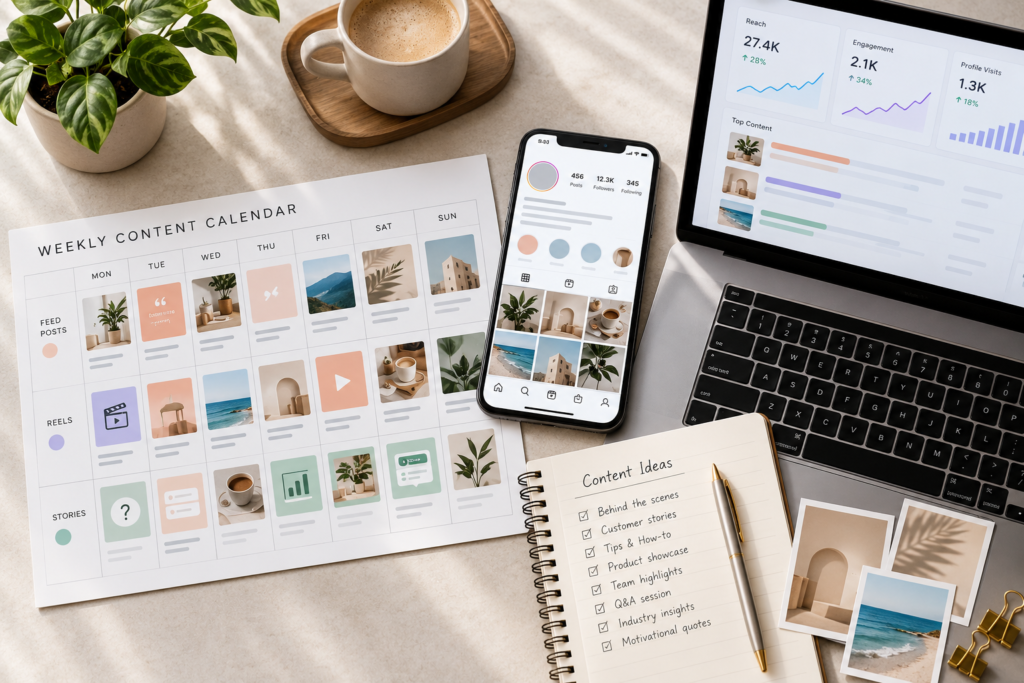
If you run a business account, you’ve probably heard conflicting advice. One expert says post every day. Another says three times a week is plenty. Someone else swears by posting twice daily or not at all on weekends.
The honest answer is that there’s no universal number, but there are useful guidelines. This guide explains how many Instagram posts per day (or per week) make sense for a business, how that differs between feed posts, Reels, and Stories, and how to pick a schedule you can actually keep up.
The Short Answer
For most businesses, you don’t need to post to your feed every day. A common benchmark from social media research is around three to five feed posts per week, with Stories used far more often. Hootsuite’s guidance, for example, suggests 3 to 5 Instagram posts per week and around two Stories per day, while noting that the businesses it measured were posting more often than that on average.
At the same time, Instagram’s head Adam Mosseri has said there isn’t a golden rule, and that posting more often doesn’t cost you followers, as reported in SocialPilot’s analysis and Hootsuite’s. In other words, the floor is about consistency, and the ceiling is about what you can sustain without letting quality drop.
A practical way to put it:
- Feed posts and Reels combined: roughly 3 to 7 per week for most small and mid-sized businesses
- Stories: a few per day, most days
- Maximum worth considering per day: one to two feed posts or Reels, only if quality holds
Why Posting Frequency Matters (and Why It Isn’t Everything)
Posting more often gives you more chances to be seen, to be saved, and to appear in front of new people. Buffer’s analysis of 2.1 million posts from about 102,000 Instagram accounts found a strong positive relationship between posting frequency and follower growth, though that shows correlation rather than proof that posting more causes growth. Accounts that grow often also have more resources and stronger content.
The takeaway is balanced:
- Frequency helps, but only when the content is worth seeing.
- Quality and relevance come first. Ten forgettable posts rarely beat three useful ones.
- Consistency beats bursts. Posting daily for a week and then disappearing is weaker than a steady rhythm.
- Your capacity is the real limit. The best schedule is the one you can maintain for months.
How Often to Post by Format
Instagram has several formats, and each one works differently.
Feed posts (photos and carousels)
Feed posts live on your profile and are useful for evergreen, saveable content: guides, product showcases, announcements, and educational carousels. For most businesses, two to four a week is a sensible starting range.
Reels
Reels are a major route to reaching people who don’t follow you. Dash Social’s data suggests engagement was highest for accounts posting around two to three Reels per week, but any study like this reflects specific accounts and time periods. For most businesses, a realistic target is one to three Reels a week, as long as each has a clear idea and good execution.
Stories
Stories are short-lived and aimed mainly at people who already follow you. They’re well suited to daily, low-pressure updates: behind-the-scenes, polls, questions, quick tips, offers, and reposting customer content. Posting several Stories a day, on most days, helps you stay visible without demanding the polish of a feed post.
Live
Lives are optional. Use them occasionally for Q&As, launches, or events rather than as part of a rigid schedule.
What’s a Realistic Schedule?
Here are three examples to adapt, depending on how much time and capacity you have. These are starting points, not rules.
| Level | Feed posts / Reels | Stories | Best for |
|---|---|---|---|
| Starter | 2 to 3 per week | A few per week | Solo founders and very small teams |
| Steady | 3 to 5 per week | Most days | Small businesses with a part-time content owner |
| Active | 5 to 7 per week | Daily | Teams with dedicated content support, or brands in high-frequency categories |
If you’re unsure, start at “Starter” or “Steady,” keep it up for two or three months, and review the results before increasing.
Factors That Affect How Often You Should Post
Your industry and audience
Posting norms differ by category. Fashion, food, and lifestyle brands often post more because their products are visual and fast-moving. B2B and professional services can do well with fewer, more substantial posts. Look at what your audience engages with and how often competitors post, then adapt.
Your resources
Be realistic about time, people, and budget. A small team that posts seven times a week with rushed, generic content will often do worse than one that posts three well-planned pieces.
Your goal
- Awareness: more Reels and shareable content
- Community and loyalty: more Stories, replies, and interactive content
- Leads and sales: a mix of educational content, proof, and clear calls to action
The quality you can maintain
If increasing frequency lowers quality, scale back. A smaller number of strong pieces is a better use of effort.
Your results
Review your Instagram Insights. If a certain format consistently gets more reach, saves, or enquiries, post more of it and less of what doesn’t work.
How to Plan Content So Frequency Is Sustainable
The hard part isn’t deciding on a number. It’s keeping up with it. A few habits help.
1. Build content pillars
Decide on three to five repeating themes, such as education, product, behind-the-scenes, customer proof, and personality. Pillars remove the daily “what should I post?” problem and keep the account focused. A written content strategy helps you decide which topics support which business goals.
2. Batch your production
Shoot and edit several posts in one session. Batching is usually more efficient than creating one post at a time, and it helps keep visuals consistent.
3. Use templates and a visual system
Reusable templates for carousels, quote posts, announcements, and Stories speed up production and make your account recognisable at a glance. A defined brand identity with fixed colours, fonts, and layout rules makes templates easy to produce, and consistent graphic design assets keep the feed looking intentional.
4. Repurpose
One idea can become a Reel, a carousel, a few Stories, and an email. Repurposing lets you post more often without constantly inventing new material.
5. Use a content calendar
Plan at least two to four weeks ahead, including key dates, launches, and festive periods. Leave room for spontaneous content too.
6. Bring in real content
Customer photos, reviews, and creator-style UGC videos can fill part of your calendar with content that feels authentic and doesn’t all have to come from your own team.
7. Consider outside support
If you know what you want to post but can’t keep up, ongoing social media marketing support can take over planning, design, and scheduling.
Does Posting Time Matter?
Timing can matter, but it matters less than content quality and consistency. Use Instagram Insights to see when your own followers are most active, then test a few time slots. Best-time charts based on other accounts are only a rough guide, since your audience may behave differently.
Common Mistakes With Posting Frequency
- Posting daily just to hit a number. Low-quality filler can hurt more than it helps.
- Posting heavily, then disappearing. Gaps break momentum.
- Ignoring Stories. They’re one of the easiest ways to stay visible with existing followers.
- Only promoting. Mix value, proof, and personality alongside offers.
- Not engaging. Replying to comments and messages matters as much as posting.
- Changing strategy too fast. Test a schedule for several weeks before judging it.
- Ignoring data. Insights show which formats and topics earn attention.
- Neglecting the profile and link. More posts won’t help if the profile and destination don’t convert.
How to Know If Your Posting Frequency Is Working
Track a few measures over a month or two:
- Reach and impressions: whether more people are seeing your content
- Saves and shares: signs that content is useful
- Profile visits and follower growth: whether content attracts new people
- Link clicks, messages, and enquiries: whether the account drives action
- Engagement by format: which of Reels, carousels, and Stories works best
If metrics improve when you post more, increase gradually. If they stay flat or quality slips, go back and strengthen the content before adding volume. If Instagram is meant to drive traffic or sales, pair it with a website built to convert, such as through web design and development, and consider supporting strong organic posts with performance marketing when you’re ready.
A Simple Weekly Template
Here’s an example week for a small business on the “Steady” plan:
- Monday: Educational carousel
- Tuesday: Stories (poll or question)
- Wednesday: Reel (tip, demo, or behind-the-scenes)
- Thursday: Stories (customer reply or testimonial)
- Friday: Product or service post with a clear call to action
- Saturday: Reel or customer-generated content
- Sunday: Light Stories or rest
Adjust the days and formats to fit your audience and capacity.
Final Thought
For most businesses, the right answer isn’t a certain number of Instagram posts per day. It’s a rhythm you can maintain with content that’s worth seeing. Start with a manageable schedule, protect quality, review your data, and increase frequency only when it’s working.
If you’d like help planning a content calendar, building templates, or producing steady Instagram content, talk to Akkenna.
FAQ
How many times a day should a business post on Instagram? Most businesses don’t need to post to the feed every day. Many do well with about three to five feed posts or Reels per week plus Stories on most days. If you post daily, make sure quality stays high.
Is it bad to post on Instagram multiple times a day? Not inherently. Instagram’s head has said posting more doesn’t cost you followers. The risk is lower quality and burnout, so only post more often if you can keep the content good.
How many Instagram Stories should I post per day? Many guides suggest a few per day, with around two a day often cited as a baseline. Posting Stories on most days helps you stay visible to existing followers.
How many Reels should a business post per week? A realistic range for many businesses is one to three per week. Focus on clear ideas and good execution rather than volume alone.
Does posting more often get more followers? Research such as Buffer’s analysis shows a positive relationship between posting frequency and follower growth, but correlation isn’t proof. Content quality and audience fit matter just as much.
What is the best time to post on Instagram? It depends on your audience. Use your own Instagram Insights to find when your followers are active, and test different times rather than relying only on general charts.
Can I schedule Instagram posts in advance? Yes. Scheduling tools help you plan and batch content, and Instagram also supports scheduling in its own tools for business accounts. Check the current options available to you.
What should I do if I can’t post consistently? Reduce the schedule to something sustainable, batch your content, use templates, and repurpose material. Consistency at a lower frequency beats an ambitious schedule you can’t maintain.
