How to Create an Effective Social Media Strategy: A Step-by-Step Guide
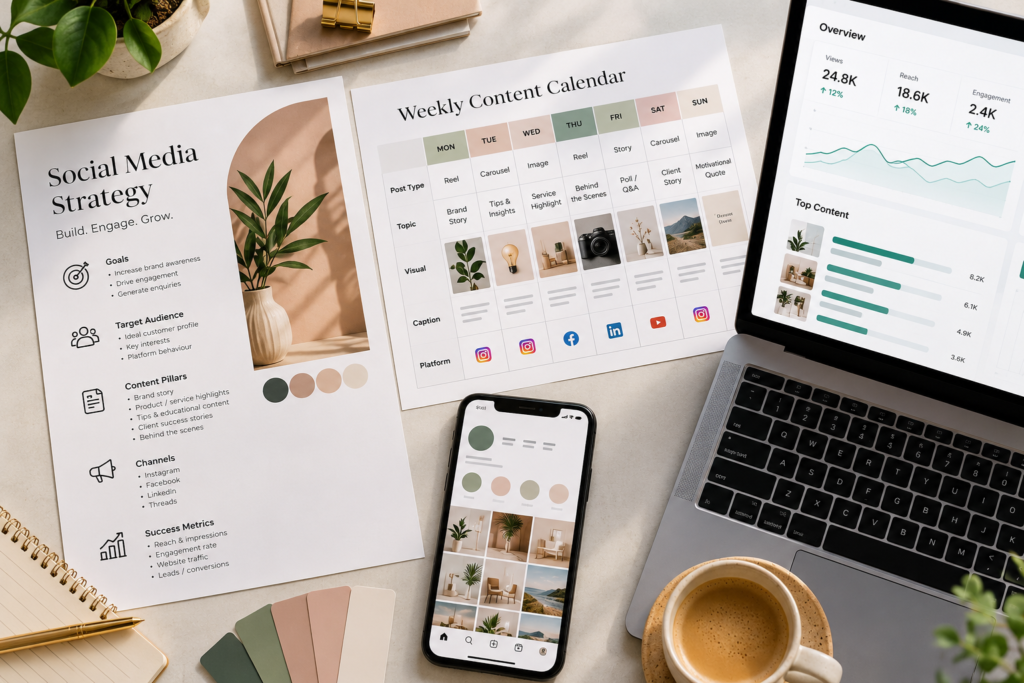
Plenty of businesses are active on social media without having a strategy. They post when they remember, copy what competitors do, chase whatever is trending, and then wonder why the numbers don’t connect to anything that matters.
A social media strategy fixes that. It’s a documented plan that explains why you’re on social media, who you’re trying to reach, what you’ll say, where and how often you’ll publish, and how you’ll know it’s working. This guide shows how to create an effective social media strategy in practical steps, whether you’re a small business, a growing brand, or a marketing team starting from scratch.
What Is a Social Media Strategy?
A social media strategy is a plan that links your social media activity to business goals. It answers:
- Why are we using social media?
- Who are we trying to reach?
- What will we say and show?
- Where will we publish?
- How often and in what formats?
- How will we measure success and improve?
It’s different from a content calendar. A calendar lists what you’ll post and when. A strategy explains the thinking behind it, so the calendar has direction.
Why a Social Media Strategy Matters
Without a plan, social media tends to drift. A strategy helps you:
- Focus effort on the channels and content that matter
- Keep your message and look consistent
- Make decisions faster, since there’s a reference for what fits
- Connect activity to goals like enquiries, sales, or recruitment
- Measure results and improve over time
- Spend time and budget more deliberately
Step 1: Set Clear Goals
Start with what you want social media to do for the business. Common goals include:
- Building brand awareness
- Growing a relevant audience
- Generating leads or enquiries
- Driving website traffic
- Increasing sales
- Supporting customer service
- Building community and loyalty
- Recruiting talent
Choose a few goals, not all of them. Then make them specific and measurable. “Get more followers” is vague. “Generate 20 qualified enquiries a month from Instagram within six months” is a goal you can track. (Treat any numbers as examples, and set targets based on your own starting point and capacity.)
Link each social goal to a business objective, so the strategy supports something that matters beyond likes.
Step 2: Understand Your Audience
You can’t create relevant content without knowing who it’s for. Define your target audience:
- Who they are: age range, location, profession, interests
- What they need: problems, questions, and goals
- Where they spend time: which platforms they use and how
- What content they respond to: formats, topics, and tone
- What makes them buy or enquire: triggers and concerns
Use real sources: customer conversations, sales team feedback, comments and messages, website analytics, and existing social insights. Build one to three audience profiles you can keep in mind when planning content.
Step 3: Define Your Brand Positioning and Voice
Social media is where your brand becomes visible daily, so it needs a clear point of view. Be clear on:
- What you stand for and what makes you different
- The personality your brand should show
- The tone of voice you’ll use, and how it changes by situation
- What topics you will and won’t engage with
If this isn’t defined, your content will sound like everyone else’s. Working through brand strategy first gives your social media something distinctive to communicate, and a documented voice makes it easier for everyone who posts to sound consistent.
Step 4: Audit Your Current Presence and Competitors
Review what you already have and what the market looks like.
Audit your accounts
- Which platforms are you on, and are they all active?
- Is your profile information complete and consistent?
- Which posts have performed best, and why?
- Where do followers and enquiries actually come from?
Look at competitors and peers
- Which platforms do they use?
- What content do they publish, and how often?
- What seems to get engagement?
- Where are the gaps you could fill?
The aim isn’t to copy anyone. It’s to see what’s normal in your category and where you can be different.
Step 5: Choose the Right Platforms
You don’t need to be everywhere. Pick the platforms where your audience spends time and where your content type fits.
- Instagram: Strong for visual brands, lifestyle, retail, food, fashion, and service businesses that benefit from showing results.
- Facebook: Useful for local communities, events, and broader age groups.
- LinkedIn: Strong for B2B, professional services, thought leadership, and recruitment.
- YouTube: Suits long-form education, demos, and searchable video content.
- X (Twitter): Useful for real-time conversation and news-led topics.
- Pinterest: Works for inspiration-led categories such as design, fashion, home, and weddings.
- WhatsApp and email: Not social networks in the same sense, but valuable for direct communication with customers.
Start with one to three platforms you can maintain well. It’s better to do two channels properly than five poorly.
Step 6: Define Your Content Pillars and Formats
Content pillars are the recurring themes that keep your content focused. For most businesses, three to five works well. Examples:
- Education: tips, guides, explainers
- Product or service: features, demos, use cases
- Proof: testimonials, reviews, case studies, results
- Behind the scenes: process, team, culture
- Community and personality: opinions, values, events, user content
Then match formats to your goals and platforms:
- Short-form video for reach and discovery
- Carousels and guides for education and saves
- Stories and polls for engagement
- Long-form video for depth
- Text posts and articles for thought leadership
- Live sessions for Q&As and events
Video often does heavy lifting in a social strategy. Options such as creator-style UGC videos, animated explainers, and motion graphics can help you produce attention-grabbing content without relying only on live shoots. A documented content strategy ties pillars, formats, and topics to your goals.
Step 7: Build a Consistent Visual Identity
On social media, recognition happens in seconds. Consistent visuals help people know it’s you before they read the name. Define:
- Logo usage and profile images
- Colours and typography
- Photography or illustration style
- Templates for posts, Stories, and covers
- Video style, including captions, titles, and transitions
A defined brand identity gives every post a visual foundation, and consistent graphic design assets such as reusable templates make production faster while keeping the feed looking intentional.
Step 8: Plan Your Posting Schedule
Decide how often to post on each platform and when. There’s no universal number, and the right frequency depends on your resources and the quality you can sustain. For many businesses, a steady schedule of a few feed posts or videos each week, plus regular Stories or short updates, is a realistic starting point. We cover this in more detail in [How Many Instagram Posts Per Day for a Business?].
Build a content calendar covering the next four to eight weeks, including:
- Key dates, launches, and campaigns
- Festive and seasonal moments relevant to your audience
- A balance of content pillars
- Formats for each platform
- Owners and deadlines for each piece
Leave some room for timely or reactive content, and review the plan regularly.
Step 9: Plan How You’ll Engage
Social media is two-way. Decide in advance how you’ll:
- Respond to comments and messages, and how quickly
- Handle questions, complaints, and negative feedback
- Engage with other accounts in your community
- Encourage user-generated content and reviews
- Escalate sensitive issues to the right person
A short response guide with tone examples helps everyone handle conversations consistently.
Step 10: Decide Your Budget and Resources
Be realistic about time, people, and money. Consider:
- Who plans, creates, publishes, and monitors the content
- Tools for scheduling, design, editing, and analytics
- Production costs for photography, video, and design
- Budget for paid promotion
- Whether to use freelancers, an in-house team, or an agency
If you lack capacity, ongoing social media marketing support can handle planning, content creation, and publishing while you focus on the business.
Step 11: Use Paid Promotion Strategically
Organic social media is valuable, but paid promotion can extend reach and support specific goals. Paid campaigns work best when:
- You’ve already seen which organic content resonates
- You have a clear objective, such as leads, traffic, or sales
- Your landing page or profile is ready to convert visitors
- You test a few creatives and audiences before scaling
- You track cost per result, not just clicks
Structured performance marketing connects ad spend to measurable outcomes and helps you refine targeting and creative over time.
Step 12: Connect Social Media to Your Website
Social media rarely works alone. If your goals involve enquiries or sales, make sure the next step is clear and the destination is ready. That means clear links in bio and posts, landing pages that match what the post promised, fast loading, a mobile-friendly experience, and simple forms or checkout. Strong web design and development helps turn social attention into action.
Step 13: Measure, Review, and Improve
Track results against the goals you set in Step 1. Useful measures by goal:
| Goal | What to track |
|---|---|
| Awareness | Reach, impressions, video views, follower growth |
| Engagement | Comments, shares, saves, replies |
| Traffic | Link clicks, website sessions from social |
| Leads | Enquiries, form submissions, messages, calls |
| Sales | Orders, revenue, cost per acquisition |
| Community | Mentions, user-generated content, sentiment |
Review monthly. Look at what worked, what didn’t, and why. Double down on formats and topics that perform, drop what doesn’t, and adjust the strategy as your goals, audience, or platforms change. A full review every quarter helps keep the strategy current.
A Simple Social Media Strategy Template
You can capture your plan on a page. A useful structure:
- Goals: the two or three outcomes you want
- Audience: who you’re reaching and what they need
- Positioning and voice: what you stand for and how you sound
- Platforms: where you’ll be present and why
- Content pillars and formats: what you’ll post
- Visual identity: logo, colours, fonts, templates
- Schedule: frequency and calendar
- Engagement plan: how you’ll respond and interact
- Budget and roles: who does what, and what you’ll spend
- Measurement: metrics, reporting rhythm, review dates
Common Social Media Strategy Mistakes
- No clear goal. Activity without purpose is hard to measure or justify.
- Trying to be on every platform. Spreading thin lowers quality.
- Talking about yourself only. Mix value, proof, and personality with promotion.
- Inconsistent visuals and voice. It weakens recognition.
- Chasing every trend. Use trends that fit your brand and audience.
- Ignoring comments and messages. Engagement builds trust.
- Neglecting the website. Social attention needs a good destination.
- Not tracking results. Without data, you can’t improve.
- Setting and forgetting. Strategy should evolve as the business and platforms change.
- Expecting overnight results. Social media growth usually takes sustained, consistent effort.
Final Thought
An effective social media strategy isn’t about posting more. It’s about being clear on what you want, who you’re talking to, what you stand for, and how you’ll measure progress. Start with focused goals, choose a few platforms, create consistent content, and review your results regularly.
If you’d like help building a social media strategy, producing content, or connecting social channels to your website and campaigns, talk to Akkenna.
FAQ
What is a social media strategy? A social media strategy is a plan that explains why you’re on social media, who you want to reach, what you’ll publish, where and how often, and how you’ll measure results, so your activity supports business goals.
How do I create a social media strategy from scratch? Set clear goals, understand your audience, define your brand voice, audit your current presence and competitors, choose platforms, plan content pillars and a schedule, and set up measurement and review.
How many platforms should a business be on? Start with one to three where your audience is active and you can maintain quality. You can add more as your capacity grows.
How often should I update my social media strategy? Review performance monthly and revisit the full strategy quarterly or whenever your goals, audience, or platforms change.
What should a social media strategy include? Goals, target audience, brand voice, platforms, content pillars and formats, visual identity, posting schedule, engagement plan, budget and roles, and measurement.
What’s the difference between a social media strategy and a content calendar? A strategy explains the goals and reasoning behind your social activity. A content calendar is the schedule of what you’ll post and when, built from that strategy.
How do I measure social media success? Match metrics to goals: reach and follower growth for awareness, comments and saves for engagement, link clicks for traffic, enquiries for leads, and orders for sales.
Do small businesses need a social media strategy? Yes. Even a simple one-page plan helps small businesses focus limited time on the platforms and content that matter most.
