What is content in digital marketing?
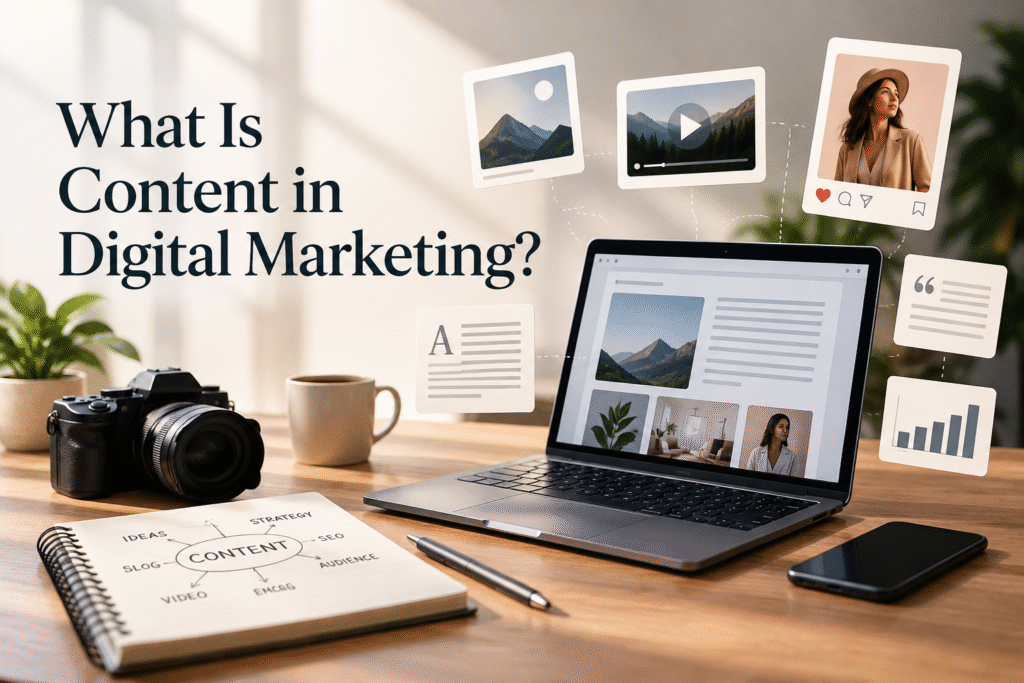
Content in digital marketing is any material, written, visual, audio or video, that a brand creates and shares to inform, engage or persuade its audience. This includes blog posts, social media, videos, emails and web pages. Unlike a direct advertisement, content usually leads with value or information first, with the brand’s offer supporting it rather than being the whole message.
What counts as content
Content spans far more than blog posts. The main formats a business typically works with are:
- Written content: blog posts, website pages, product descriptions, email newsletters
- Visual content: social media graphics, infographics, photography
- Video content: UGC videos, explainer videos, reels and shorts, product demos
- Audio content: podcasts, voice notes for social platforms
- Interactive content: quizzes, calculators, downloadable guides
Each format suits a different part of how a customer discovers, considers and decides to buy from a brand.
Content vs. advertising: the key difference
The two often get confused, but they work differently.
| Content | Advertising | |
|---|---|---|
| Leads with | Information, entertainment or value | The offer itself |
| Typical goal | Build trust, answer questions, stay visible in search | Drive an immediate action |
| Example | A blog post answering “how much do branding agencies charge” | An ad saying “book a brand audit today” |
| Lifespan | Can keep working for months or years, especially in search | Stops working once the spend stops |
Most effective marketing uses both together: content earns attention and trust over time, and advertising accelerates specific actions.
Why content matters for a brand
- It builds search visibility. Well-written content is what search engines and AI answer tools actually index and reference, which is why blog content directly supports SEO and AI visibility.
- It builds trust before a sale. A customer who reads a helpful post or watches a useful video arrives at a purchase decision already trusting the brand a little more.
- It supports every other channel. Social media, email and paid ads all need content to fill them, and consistent content makes those channels stronger.
- It compounds over time. Unlike an ad, a good blog post or video can keep bringing in traffic and enquiries long after it’s published.
The main types of content a business needs
| Content type | Purpose | Where it lives |
|---|---|---|
| Educational content | Answers questions, builds trust and SEO | Blog, website |
| Social content | Keeps the brand visible and engaged with | Instagram, LinkedIn, YouTube |
| UGC and video content | Builds credibility through real people | Reels, ads, product pages |
| Email content | Nurtures leads and existing customers | Inbox |
| Sales content | Supports a direct buying decision | Landing pages, product pages |
Most brands need a mix, not just one type, since each does a different job in the customer’s journey.
Content needs a strategy, not just output
Publishing content without a plan usually produces a scattered mix that doesn’t build on itself. Deciding what to create, for whom, and how often, is what turns content from a list of posts into something that actually moves a business forward. That planning work is what content strategy covers.
If your content currently feels like a collection of one-off posts rather than something building toward a goal, it may be time to build a content strategy that ties every piece back to your audience and your brand. Akkenna, a holistic branding agency in Coimbatore, plans content alongside brand identity and search visibility, so what you publish reinforces the same brand everywhere it appears.
Frequently asked questions
Is social media considered content marketing?
Yes. Social posts are one format of content, alongside blogs, videos and email. Content marketing usually spans several formats rather than relying on just one.
What’s the difference between content and content marketing?
Content is the material itself, a blog post, a video, a graphic. Content marketing is the strategy behind creating and distributing that content to reach business goals.
How much content does a small business actually need?
Consistency matters more than volume. A steady rhythm of a few well-made pieces a month usually outperforms a large volume of rushed content.
Does content marketing work for every industry?
Yes, though the format that works best varies. Visual and video content tend to perform well for jewellery, food and fashion, while educational written content suits healthcare, finance and B2B categories.
Want content that actually builds your brand?
A short brand audit shows where your content is inconsistent or missing, and what to prioritise. Book a brand audit with the Akkenna team.
