2D vs 3D Explainer Videos: Which Should You Choose?
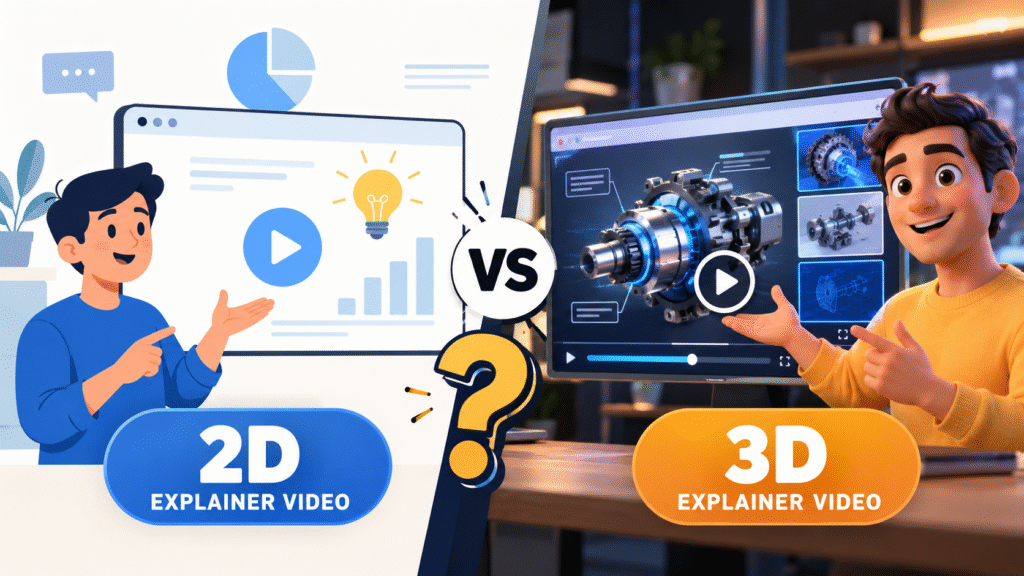
Choose a 2D explainer video for abstract ideas, services and processes, where speed and budget matter most. Choose a 3D explainer video when your product is physical and benefits from depth, realism or rotation, such as machinery, architecture or a detailed product. 2D typically costs 40-60% less and delivers 2-4 weeks faster than 3D.
What each style actually is
2D explainer videos use flat illustration, vector graphics and motion graphics to walk a viewer through an idea. They’re known for simplicity and versatility, which is why they’re the default choice for most business explainers.
3D explainer videos use three-dimensional models with real depth and perspective, closer to what you’d see in a product render or architectural walkthrough. They’re stronger when the subject is physical and benefits from being seen from multiple angles.
2D vs 3D at a glance
| Factor | 2D | 3D |
|---|---|---|
| Best for | Abstract ideas, services, processes | Physical products, machinery, architecture |
| Upfront cost | Lower | Higher |
| Production time | Faster, roughly 2-4 weeks | Slower, roughly 4-8 weeks |
| Revisions | Quick to update | Slower and costlier to change |
| Perception | Approachable, friendly, practical | Premium, modern, high-impact |
| Reuse of assets | Limited, often redrawn per project | Can be reused across angles and variants |
When 2D is the right choice
- Your idea is conceptual, like explaining a service, a process or a business model, rather than a physical object.
- Your budget or timeline is tight. 2D typically costs 40-60% less than 3D for a comparable video length, and gets delivered faster.
- You expect to update the video. 2D assets are easier to modify, swap or extend as your offering changes.
- You want a distinctive illustrated style tied to your brand, rather than realism.
This covers most explainer needs, which is why 2D carries the majority of business explainer videos.
When 3D is worth the investment
- Your product is physical and detailed, and customers need to see it from multiple angles to understand it, jewellery, machinery, devices or architecture.
- You want a premium, high-impact feel for a launch or a flagship product.
- You’ll reuse the same models across several videos, ads or angles, which spreads the higher upfront cost over more content.
- Realism itself is the message, for example showing exactly how a physical space or mechanism works.
What it costs
Global industry data gives a rough sense of scale for a 60-second explainer:
| Style | Typical range (60 seconds, global data) | Estimated India range |
|---|---|---|
| 2D | $2,500-$7,500 | ₹1 lakh-₹4 lakh |
| 3D | $5,000-$25,000 | ₹2 lakh-₹10 lakh+ |
These India figures are estimated, converted and scaled from international pricing data, since I found no verified India-specific rates. Please confirm against your own production costs before publishing.
You don’t have to choose just one
Many explainer videos blend both styles: 2D motion graphics for abstract points, layered over 3D footage or renders for the physical product itself. If your story has both a conceptual side and a physical hero product, a hybrid approach often communicates more than committing fully to either style.
A simple way to decide
Ask these three questions before choosing a style:
- Is what I’m explaining physical or abstract? Physical leans 3D, abstract leans 2D.
- What’s my budget and timeline? Tighter constraints lean 2D.
- Will I need to update or reuse this content often? Frequent updates lean 2D; reused product assets can justify 3D.
If most answers point to 2D, that’s usually the safer starting choice, with the option to add a 3D moment later if the product specifically needs it.
Get the right explainer for your product
The right style depends on what you’re actually explaining, not which one looks more impressive. If you want help matching the format to your product and budget, rather than guessing, work with a team that scopes the video around your actual goal. Akkenna, a holistic branding agency in Coimbatore, produces both 2D and 3D explainer videos as part of a connected content and brand strategy, so the format fits the message, not the other way around.
Frequently asked questions
Is 3D always more expensive than 2D?
Usually yes upfront, since 3D requires modelling and rendering. But if you reuse the same 3D assets across multiple videos or angles, the cost per use can become more efficient over time.
Can I switch from 2D to 3D later if my budget grows?
Not directly, since the two are built differently from the ground up. Most businesses start with 2D and commission a separate 3D video later if the product justifies it.
Which style converts better?
Neither style wins outright. A clear, well-scripted 2D video can perform as well as a polished 3D one. The message and clarity usually matter more than the animation style.
How long does an explainer video take to produce?
2D typically takes 2-4 weeks, and 3D typically takes 4-8 weeks, depending on complexity and revision rounds.
Not sure which style fits your product?
A short brand audit can help match the right explainer format to your budget and goals. Book a brand audit with the Akkenna team.
