
What Is User-Generated Content?
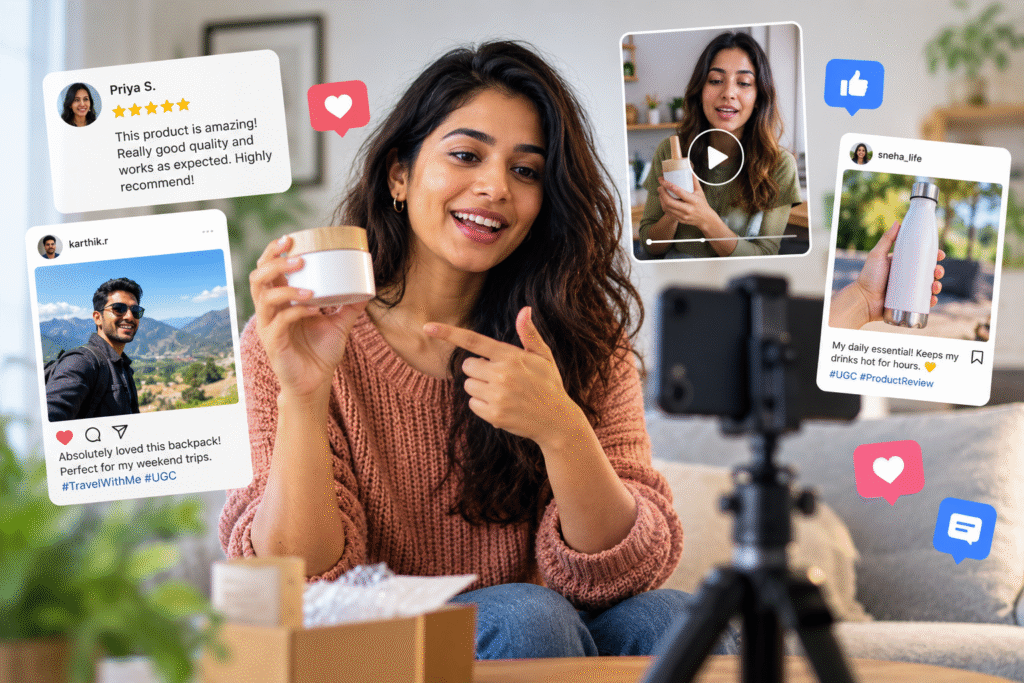
User-generated content (UGC) is any content, such as photos, videos, reviews or posts, created by customers, fans or creators rather than by the brand itself. Brands share, reuse or commission it because it feels authentic and builds trust faster than polished brand advertising.
What UGC looks like in practice
UGC covers most formats a brand might otherwise produce itself:
- Photos and videos of customers using a product
- Reviews and testimonials on Google, Instagram or a website
- Unboxing and “haul” videos
- Social posts that tag or mention the brand
- Before and after content shared by real customers
- Creator-made videos filmed in a customer-style voice, often commissioned by the brand
The defining feature is the voice: it comes from a real person speaking about the product, not from the brand speaking about itself.
What is UGC on Instagram and social media?
On Instagram, TikTok and YouTube, UGC usually appears as reels, stories, tagged posts and reviews made by customers or creators. Brands typically use it in three ways:
- Reposting customer content on their own accounts, with permission.
- Featuring it on product pages, websites and email campaigns.
- Running it as ads, where the creator’s video is used in paid campaigns because it looks native to the feed.
Social platforms reward content that feels native, and UGC fits that pattern more naturally than a studio-shot advert.
UGC in marketing: organic vs. commissioned
Not all UGC arrives on its own. Brands generally work with two types:
| Type | How it happens | Best for |
|---|---|---|
| Organic UGC | Customers post about you without being asked | Social proof, community, reposting |
| Commissioned UGC | Brand briefs a creator or customer to make content | Ads, product launches, controlled messaging |
Commissioned UGC is still called UGC because the style stays authentic: a person talking to camera, filmed on a phone, rather than a scripted studio production. Brands often use it in paid social because they can control the brief, the offer and the timing.
UGC vs. influencer content vs. brand content
The three overlap, but they aren’t the same.
| Content type | Who creates it | Style | Typical use |
|---|---|---|---|
| Brand content | The brand or its agency | Polished, on-message | Website, campaigns, launches |
| Influencer content | A creator with a large audience | Personality-led, sponsored | Reach and awareness |
| UGC | A customer or creator, usually without a large following | Casual, authentic | Trust, conversion, paid social |
The difference is less about follower count and more about how the content feels: UGC reads as a real person’s experience, not as a brand campaign.
Why brands use UGC
- It builds trust. People rely on other people’s experiences when deciding, especially in categories like jewellery, beauty, healthcare and food.
- It looks native. Content that resembles what people already scroll through tends to hold attention better than obvious advertising.
- It costs less to produce than a studio shoot. Filming on a phone by a creator or customer is typically cheaper than a full production.
- It gives you a steady supply of content. Customers and creators can produce volume that would be slow to make in-house.
What to watch for
UGC works best when it’s handled carefully:
- Get permission before reposting a customer’s content, and credit them.
- Brief creators clearly when commissioning, including the offer, tone and any claims to avoid.
- Stay consistent with your brand. Authentic doesn’t have to mean off-brand, so brief creators on tone, colour and messaging.
- Avoid unverified claims. This matters most in healthcare, wellness and beauty, where content must follow advertising rules.
Turning UGC into a repeatable system
Random UGC helps, but a planned approach works better: deciding what content to collect, how to brief creators, where to use it, and how to measure results. If you’d like to get UGC videos created for your brand instead of waiting for them to appear, work with a team that briefs, produces and tests them for paid and organic use. Akkenna, a holistic branding agency in Coimbatore, plans UGC alongside brand identity and content strategy, so the videos feel authentic while still fitting the brand.
Frequently asked questions
Is user-generated content free?
Organic UGC costs nothing to receive, though you need permission to reuse it. Commissioned UGC involves creator fees, which are usually lower than a studio production.
Do I need permission to repost customer content?
Yes. Ask for permission and credit the creator, even if the post tags your brand. Getting it in writing or via a clear message protects both sides.
What is the difference between UGC and influencer marketing?
Influencers are chosen for their audience size and reach. UGC creators are valued for the content itself, and they often have small followings. The two can overlap.
Does UGC work for every industry?
It works widely, though the format varies. It suits visual and trust-driven categories like jewellery, beauty, fitness and food especially well.
Want UGC that fits your brand?
A short brand audit shows where real-people content could build trust across your channels. Book a brand audit with the Akkenna team.
