How to Develop Your Brand: A Practical Guide for Growing Businesses
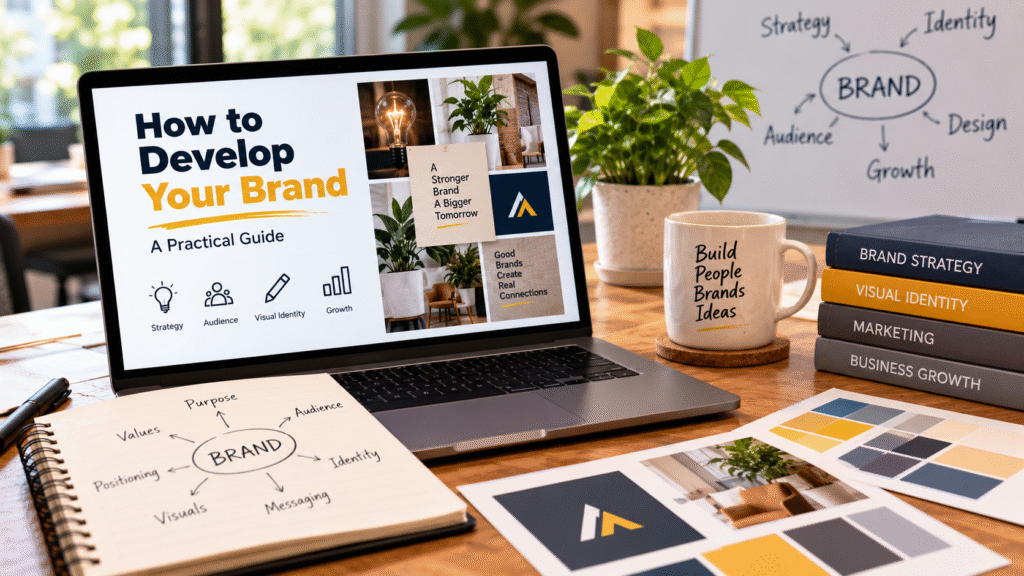
A business owner messages their designer: “Can you just make our brand feel more premium?” The designer asks what that means. Silence. This happens constantly, because “developing your brand” is one of those phrases everyone uses and almost nobody defines before starting.
So here’s a working definition: developing your brand means deliberately shaping how your business is perceived, through positioning, visual identity, voice and consistent experience, rather than letting perception form by accident. It’s not one task. It’s an ongoing practice, with some concentrated projects along the way.
First, how is this different from “building” a brand?
Building usually refers to the first version, the starting identity for a new or young business. Developing applies once something already exists and needs to grow, sharpen or change direction. If you’re starting from zero, read how to build a brand identity instead. This post is for businesses that already have a name, a logo, maybe a few years of history, and sense that something isn’t working as well as it should.
The signs it’s time to develop your brand further
Most businesses don’t wake up one day and decide to “develop their brand.” They notice specific discomforts first:
- Customers keep comparing you on price, because they can’t articulate any other reason to choose you.
- Your Instagram, your website and your shop don’t feel like the same business.
- You’ve outgrown the audience your brand was originally built for.
- A competitor who entered the market after you now looks more credible.
- You’re embarrassed to send someone to your own website.
Any one of these, on its own, might not justify a project. Two or three together usually do.
The mistake most businesses make at this point
They jump straight to a new logo. A fresh logo feels like progress, it’s visible, it’s exciting, it photographs well for a launch announcement. But a logo change without addressing the underlying positioning just gives the old confusion a new coat of paint. Six months later, the same complaints resurface, because the actual problem, unclear audience, inconsistent voice, outdated messaging, was never touched.
Brand development that works starts one level deeper than the visuals.
Where real brand development actually starts
Re-examine who you’re actually serving now. Businesses change. The audience you built for five years ago may not be the audience actually buying from you today. Developing your brand means checking that assumption against reality, not just updating a tagline. This is the same groundwork covered in do branding agencies help identify your target market.
Get honest about what’s not working. This sounds obvious, but it’s the step most skip. A short audit, looking at your website, social presence, packaging and customer feedback together, usually surfaces the real gap faster than guessing.
Decide what stays and what changes. Not everything needs to go. A strong name with a weak logo needs different treatment than a weak name with everything else intact. Development is selective, not a full teardown.
Rebuild the system, not just the symbol. Whatever changes, colour, type, tone, imagery, needs to work together as one system again, not as isolated fixes. See what brand identity services include for what a full system covers.
Carry it everywhere, deliberately. A developed brand that only updates the logo on the website, while packaging, social templates and signage lag behind, ends up more inconsistent than before the project started.
A short checklist before you start
Before briefing anyone, write down answers to these:
- What specifically feels wrong, in your own words, not “it needs to feel more premium”?
- Who do you actually want to attract now, not five years ago?
- What’s working that shouldn’t be touched?
- What’s your real budget, including applying changes across every channel, not just design fees?
- Who on your team will make final decisions, so feedback doesn’t stall the process?
Answering these honestly before the first design meeting saves weeks of back-and-forth later.
How long this usually takes
A full brand development project, audit through rollout, typically runs 4 to 8 weeks, depending on how much changes and how many channels need updating. A lighter refresh, keeping the core identity and sharpening messaging and consistency, can move faster, often 2 to 4 weeks.
Develop it with people who ask the uncomfortable question first
The hardest part of developing a brand isn’t the design work, it’s being willing to ask “what’s actually wrong here?” before reaching for a new logo. If you’d rather develop your brand with a team that starts there instead of jumping straight to visuals, that’s the difference a proper audit makes. Akkenna, a holistic branding agency in Coimbatore, runs that audit first, then builds the identity, content and visibility work around what it actually finds.
A couple of things people usually ask next
Is it possible to develop a brand without changing the logo at all?
Yes, and it often should stay if it’s still recognisable and not actively working against you. Development can focus entirely on messaging, consistency and extending the system, without touching the mark itself.
How do we know if we need a light refresh or a full rebrand?
A light refresh usually fits when the core identity still works but feels inconsistently applied. A full rebrand fits when the positioning itself has changed, a new audience, a new category, a name that no longer reflects the business.
Who should be involved in deciding what changes?
Keep it small. One or two decision-makers who can give clear, final feedback move a project faster than a committee, where every round of input adds a new, conflicting opinion.
Ready to find out what actually needs developing?
A short brand audit shows exactly where your brand is losing consistency or credibility, before you spend on a new logo that might not be the real problem. Book a brand audit with the Akkenna team.
