
How to Build a Brand Identity
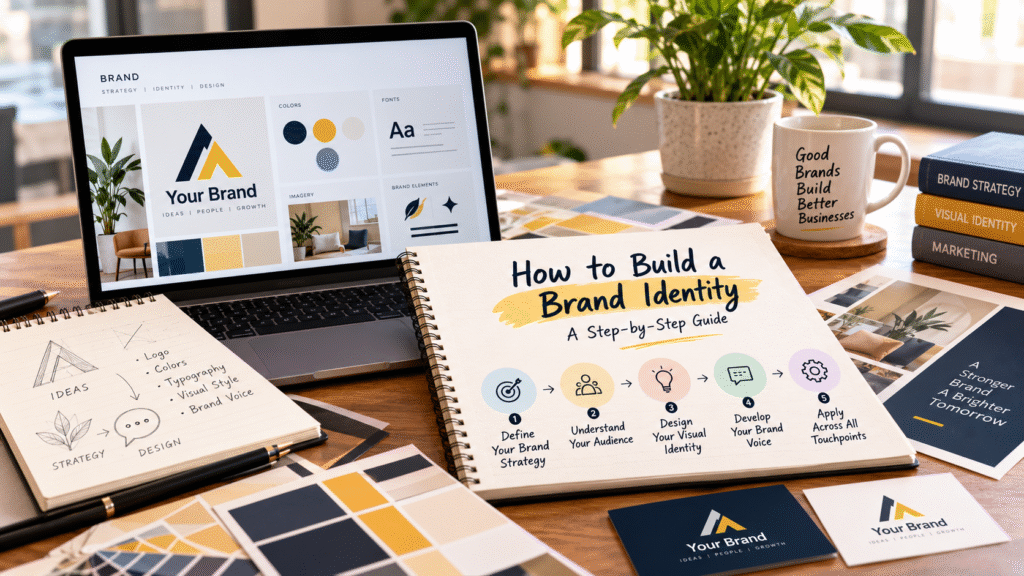
Most businesses think building a brand identity starts with a logo. It doesn’t. It starts with a question almost nobody writes down before hiring a designer: who exactly are we trying to look like, to whom? Skip that question, and the logo that comes back might be attractive, but it won’t be doing any real work.
Here’s the process in the order it actually happens, not the order most checklists list it in.
It starts with a decision nobody enjoys making
Before any colour or font gets chosen, someone has to decide who the brand is for. Not “everyone who might buy this,” but a specific group with specific expectations. A rehab clinic and a bridal jewellery showroom cannot use the same tone, even if both want to signal “trustworthy,” because trust means different things to someone in crisis and someone celebrating a wedding.
This decision is uncomfortable because it means saying no to some customers in order to say something clear to the rest. Businesses that skip it end up with an identity that tries to please everyone and ends up meaning nothing in particular. For the fuller process behind this step, see what does a brand strategist do.
Then comes research, and it’s duller than it sounds
Once you know who you’re speaking to, the next stage is unglamorous: looking at what competitors are already doing, so the identity doesn’t accidentally repeat someone else’s visual territory. A jewellery brand that picks the same deep red and gold combination as three competitors down the same street hasn’t built an identity, it’s built a copy with a different name on it.
This stage also involves listening to actual customers, through reviews, conversations or sales data, rather than guessing what they want. The research rarely produces surprises that feel dramatic. It produces small, specific facts, like “our customers care more about certification than price,” that quietly shape every creative decision after this point.
The name comes before the look
If the business doesn’t have its name settled yet, this is where that gets resolved, because a logo built around an unstable name usually gets redone. Checking a name for trademark and registration conflicts in India, and for domain and handle availability, belongs here too. It’s tedious, and it’s cheaper to do now than after signage is printed.
Now, finally, the visual thinking begins
With a clear audience and a checked name, design can start. This doesn’t mean jumping to a finished logo. It means two or three rough directions, each expressing the positioning differently, a bold and confident direction, a warm and approachable one, a minimal and premium one, so the business can react to real options instead of approving the first thing shown to them.
One of these directions gets chosen, not because it’s the prettiest, but because it fits the earlier research. The chosen direction then gets built out properly: a refined logo, a colour palette with exact codes, typography for headings and body text, and a direction for photography or illustration.
The part most businesses underestimate: writing it down
A logo file is not a brand identity. A brand identity is a logo plus a document explaining exactly how to use it, what sizes it works at, which colour combinations are allowed, how the brand should sound in writing. Without this document, every new hire, printer or freelancer makes their own interpretation, and within a year the “identity” looks like five different brands wearing the same name. See what brand identity services include for the full list of what this document should cover.
Then it has to actually go somewhere
A finished identity that sits in a folder helps nobody. The real test is applying it: to the website, to packaging if there is a physical product, to social templates, to a shop sign. This stage usually reveals small problems the design phase couldn’t predict, a colour that looks different printed than on screen, a logo that doesn’t shrink well onto a product label. Budgeting time and money for this stage, not just the design itself, is what separates an identity that works from one that only looks good in a presentation.
A rough sense of how long this takes
| Stage | What happens | Typical duration |
|---|---|---|
| Audience and positioning | Deciding who the brand is for | 1-2 weeks |
| Research | Competitors, customers, market | 1 week, often overlapping with the above |
| Naming and checks | Trademark, domain, MCA if relevant | A few days to 1 week |
| Design concepts | 2-3 directions developed | 1-2 weeks |
| Refinement and guidelines | Final system and documentation | 1-2 weeks |
| Rollout | Applying it across real channels | Ongoing after handover |
Most full projects land somewhere between 3 and 6 weeks before rollout begins, though the sequence above matters more than the calendar.
What tends to go wrong when businesses do this alone
The most common failure isn’t bad taste, it’s skipped order. A business hires a freelancer for a logo without doing the positioning work first, then separately hires someone else for the website, who never saw the logo brief, then a third person handles social media with no guidelines at all. Each piece might be competent on its own. Together, they rarely look like one brand, because nobody did the work connecting them.
If you’d rather build a brand identity the way it’s meant to happen, in the right order, with one team carrying it from positioning through to rollout, that continuity is the whole point of working with a single agency instead of three disconnected freelancers. Akkenna, a holistic branding agency in Coimbatore, runs this exact sequence for clients, so nothing gets designed before the thinking behind it is settled.
A few questions people ask partway through
Can I skip the research stage if I already know my customers well?
You can shorten it, but not skip it entirely. Even founders who know their customers well are often surprised by what a structured competitor comparison reveals, since day-to-day familiarity can miss gaps an outside look catches.
What if I already have a logo I like, can I build the rest of the identity around it?
Sometimes. If the logo genuinely reflects the audience and positioning work, it can anchor the rest. If it was designed without that groundwork, building a full system around it usually means working around its limitations rather than with them.
Do I need brand guidelines if it’s just me running the business right now?
Yes, sooner than it feels necessary. The moment you hire a designer, a social media manager or a printer, inconsistency starts creeping in without a document to refer to.
Ready to build yours the right way round?
A short brand audit shows exactly where to start, whether that’s positioning, a logo refresh, or just better guidelines for what you already have. Book a brand audit with the Akkenna team.
