Branding and Website Design: Why They Should Be Planned Together
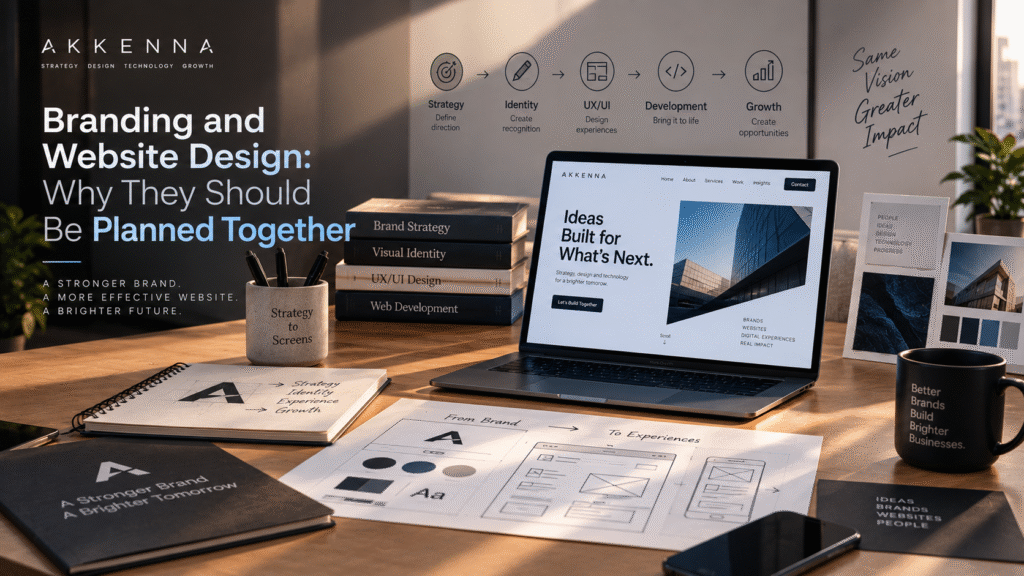
Introduction — Your Website Is Part of Your Brand
Here’s a scenario that plays out constantly. A company invests in a new logo and brand identity. Months later, a different team is brought in to build the website. The result is often technically fine and visually disjointed: one visual style in the brand guidelines, another on the site, messaging that doesn’t quite match, typography that doesn’t hold together, colours that clash rather than reinforce each other, and a brand voice on the homepage that sounds like a different company than the one on the “About” page.
The website works. It just doesn’t feel like the same company the brand identity describes.
Your brand defines what people should recognize and remember. Your website is one of the most important places where they actually experience it. When these two things are developed in isolation, the gap between them becomes the customer’s problem to reconcile — and most customers won’t bother.
None of this means the same agency has to handle both branding and website design. It means the two need to be planned as one connected effort, even when different specialists execute the work.
What Is the Relationship Between Branding and Website Design?
Branding and website design answer different questions, but they should answer them in the same direction.
Branding answers:
- Who are we?
- Who do we serve?
- What do we stand for?
- What makes us different?
- How should customers perceive us?
Website design answers:
- How should people navigate the site?
- What information should they see, and in what order?
- What actions should they take?
- How should the brand actually be experienced, digitally?
The logical sequence is Brand Strategy → Brand Identity → Website Experience. Website design shouldn’t have to invent the brand from scratch — it should translate decisions that have already been made.
Branding Is More Than a Logo
A complete brand system typically includes brand strategy, positioning, value proposition, messaging, and brand voice, alongside the visual layer: logo, colour palette, typography, photography style, illustration, iconography, graphic elements, and the guidelines that document how it all fits together.
Each of these has a direct line into website design:
- Typography shapes readability and visual hierarchy on every page.
- Colour drives interaction cues — what looks clickable, what draws attention first.
- Photography style shapes the emotional register visitors pick up in seconds.
- Brand voice becomes the actual words on the page — headlines, CTAs, microcopy.
- Graphic language — the shapes, patterns, and visual accents in the identity — often becomes the basis for UI components like cards and section dividers.
Not every brand needs all of these fully developed before a website can be built well, but whatever exists should inform the site rather than sit in a folder the website team never opens.
Why Branding and Website Design Should Be Planned Together
1. Consistency across every touchpoint
A brand is experienced across the website, social media, advertising, presentations, sales materials, email, and offline communication. The website carries particular weight because it’s often the most detailed, most visited, and most scrutinised of these touchpoints. It should feel like a natural extension of the brand, not a separate creative interpretation of it.
2. Brand strategy can influence website structure
This goes beyond visuals. If the target audience is enterprise decision-makers, the site may need clear solution architecture, case studies, credibility signals, and efficient access to detailed information — because that’s how enterprise buyers evaluate vendors. If the audience is consumers, the priority may shift toward visual storytelling, product discovery, reviews, and simpler journeys.
Brand strategy can influence UX decisions — not just colours and fonts. Who you’re building for should shape how the site is structured, not just how it looks.
3. The visual identity works better in context
A logo that looks polished in a presentation deck doesn’t automatically hold up in a website’s navigation bar, on a small mobile screen, inside a button, as a favicon, or against both light and dark backgrounds. Considering these digital applications while developing the identity — rather than after — avoids a mark that needs constant compromise once it hits a browser.
4. Messaging and website copy stay aligned
Brand positioning should show up directly in the homepage headline, service descriptions, the “About” page, product messaging, CTAs, navigation labels, and even microcopy. When website copy is written without reference to the established positioning, it tends to drift toward generic industry language — the kind every competitor’s site also uses.
5. Better UX without losing brand personality
If the intended personality is premium, confident, and sophisticated, the website can reinforce that through clear hierarchy, strong typography, high-quality imagery, restrained visual design, and simple navigation. “Premium” doesn’t mean heavy animation, visual clutter, or complicated interaction patterns — often restraint, done well, reads as more premium than excess.
6. Conversion elements can become part of the brand
CTA buttons, forms, pricing sections, product cards, testimonials, and trust signals don’t have to look like generic template components. Designed with the brand’s visual language and voice, they reinforce the brand at exactly the moments that matter most for the business.
7. Mobile experience becomes more intentional
The brand system needs to hold up across desktop, tablet, and mobile — responsive typography, spacing, navigation patterns, image treatment, and button sizing all affect whether the brand still feels recognisable on a small screen. Maintaining that recognition across screen sizes is part of digital brand consistency, not a separate mobile concern.
8. It can reduce rework
When branding is developed without any reference to how it will be used on a website, problems tend to surface later — typography that doesn’t render well at small sizes, colours that fail accessibility contrast requirements, assets that need recreating for web use, copy that needs rewriting once the site structure is clear. Planning both together can reduce avoidable revisions and conflicting design decisions, though it won’t eliminate the normal iteration any design project involves.
What Happens When Branding and Website Design Are Planned Separately?
The website looks like a template. The brand exists on paper, but the site doesn’t feel distinctive.
Inconsistent typography. Brand fonts may not perform well on screen or get applied inconsistently across pages.
Conflicting visual language. Logo, imagery, icons, and UI components look like they belong to different brands.
Generic messaging. The site defaults to standard industry phrasing rather than the brand’s actual positioning.
Weak conversion experience. The site can look attractive and still fail to guide visitors toward meaningful actions.
Mobile problems. An identity built without digital use in mind often breaks down — logos that don’t scale, colours that fail contrast requirements, cramped layouts.
None of this is inevitable. It’s simply what tends to happen when the two workstreams don’t talk to each other.
What Should Be Defined Before Website Design Begins?
Brand strategy: target audience, positioning, value proposition, differentiation, brand personality.
Brand identity: logo system, colours, typography, imagery direction, iconography, graphic elements.
Messaging: brand voice, key messages, headline direction, value propositions, CTA language.
Digital requirements: website goals, user journeys, conversion goals, content hierarchy, mobile requirements.
Not every business needs a complete rebrand before redesigning a website. Many already have enough strategic and visual foundation in place — the goal is making sure that foundation actually reaches the website team, not rebuilding it from scratch.
How Brand Strategy Influences Website UX
The chain runs Audience → Positioning → Content → UX → UI.
A B2B enterprise website may prioritise fast access to information, solution architecture, case studies, trust signals, clear calls to action, and scannable content — enterprise buyers often compare several vendors under time pressure.
An ecommerce website may prioritise product discovery, filtering, product imagery, reviews, a smooth checkout flow, and visible offers — the buying decision happens differently, often driven by browsing and comparison at the product level.
UX should reflect the needs of the audience, while UI expresses the brand. Confusing the two — treating audience research as a design preference, or treating brand identity as a UX decision — is where a lot of misalignment starts.
How Brand Identity Influences Website UI
| Brand Element | Website Application |
|---|---|
| Logo | Header, footer, favicon |
| Colours | UI hierarchy, buttons, backgrounds |
| Typography | Headings, body text, navigation |
| Brand voice | Website copy |
| Photography | Hero sections, stories, case studies |
| Iconography | Features and navigation |
| Graphic language | Cards, sections, and visual accents |
| Brand guidelines | Consistency across pages |
These are common patterns rather than fixed rules — the right application depends on the specific brand and the specific site.
Build a Brand-First Website Design System
A design system — a documented set of typography scales, colour tokens, buttons, forms, cards, navigation patterns, spacing rules, icons, image treatments, responsive behaviour, and interaction patterns — is what keeps a brand consistent as a website grows past its first few pages. Without one, every new page or section risks being designed slightly differently, and small inconsistencies accumulate quickly across a site with dozens of pages.
When Should You Do Branding Before Website Design?
New business: Brand strategy and identity can be developed before or alongside website design.
Existing business with strong branding: The current brand system can become the direct foundation for the website — no rebuild required.
Existing business with outdated branding: A brand review may be worth doing before investing heavily in a redesign, so the new site isn’t built on a foundation that also needs to change soon after.
This isn’t a universal rule — the right starting point depends on how well the existing brand holds up.
Can You Rebrand and Redesign a Website at the Same Time?
Yes. This can work well when positioning is changing, the visual identity is changing, the target audience is shifting, the website’s architecture needs to change, or the existing site no longer represents the business.
A reasonable workflow: Audit → Strategy → Identity → UX → UI → Development → Launch. The audit establishes what’s working; strategy and identity define the direction; UX and UI translate that into the actual site; development and launch bring it live.
Branding + Website Design: A Better End-to-End Process
- Understand the business — goals, audience, market, competitors.
- Define brand strategy — positioning, differentiation, messaging.
- Develop brand identity — logo, colours, typography, visual language.
- Plan website architecture — sitemap, content hierarchy, user journeys.
- Design UX — wireframes, navigation, conversion paths.
- Design UI — apply the brand identity to the interface.
- Develop — build a responsive, working website.
- Test — usability, mobile experience, accessibility, performance, forms, and brand consistency.
- Launch and evolve — the site and brand should keep evolving based on business needs and real user behaviour, not stay frozen at launch.
Should the Same Agency Handle Branding and Website Design?
Not necessarily — but the two need to be connected, whoever does the work.
One connected team offers real advantages: shared context, fewer handoffs, faster decisions, and generally tighter consistency, since the people building the site were part of the conversations that shaped the brand.
Separate specialists can also work well, provided guidelines are genuinely clear, responsibilities are well defined, and the website team understands the strategy behind the identity — not just the asset files.
The important thing is not necessarily having one agency. It’s having one connected strategy.
Common Mistakes to Avoid
Designing the logo without considering digital applications. A mark that only works at large sizes on print creates ongoing problems online.
Treating the website as a separate visual project. This is how sites end up looking like a different company than the brand identity describes.
Choosing fonts purely because they look attractive. A typeface also needs to render clearly on screen, across weights and sizes.
Using brand colours without considering accessibility. Contrast affects whether text is actually readable — see the W3C Web Content Accessibility Guidelines for the relevant standards.
Making the website visually impressive but hard to navigate. Strong visuals shouldn’t cost visitors their ability to find what they need.
Writing website copy only after the design is finished. Copy written as an afterthought rarely fits the space or flow it’s placed into.
Ignoring mobile applications of the brand system. A brand that only looks right on desktop isn’t fully considered.
Launching without a consistent design system. This is usually where inconsistency creeps back in as a site expands.
How to Know If Your Brand and Website Are Aligned
- Does the website feel immediately recognisable as the brand?
- Does the messaging match the positioning?
- Is the visual identity consistent throughout?
- Does the website actually speak to the intended audience?
- Are CTAs consistent with the brand voice?
- Does the mobile experience maintain the identity?
- Do social media and the website feel like the same company?
- Does the website communicate what actually makes the business different?
Running through this list before a launch — or before deciding whether a redesign is even necessary — is a useful gut check.
Final Takeaway
Branding tells people who you are. Website design gives them an experience of it. The sequence — strategy, identity, UX, UI, experience — only holds together when each stage is aware of the ones before it.
A website shouldn’t simply “use the logo.” It should express the brand throughout the customer journey, from the first impression on the homepage to the moment someone fills out a form or makes a purchase.
How Akkenna Can Help
Akkenna works across brand strategy, brand identity, and website design as one connected process — not two separate projects handed off between teams. That means positioning and identity decisions are made with the website in mind from the start, and UX/UI and development work are built directly on that strategic foundation, from [Brand Strategy] and [Brand Identity] through [UI/UX Design] and [Website Design & Development]. For more on how strategy and identity relate to each other, see our earlier piece, [Brand Strategy vs Brand Identity: What’s the Difference?]
Build a Brand and Website That Work Together.
FAQ
Why should branding and website design be planned together? The website is one of the primary places customers experience the brand. Planning them together keeps visual identity, messaging, and user experience aligned instead of having the site reinterpret the brand independently.
Should branding come before website design? Generally yes — a defined strategy and identity give the website something to translate rather than invent. Businesses with unclear or outdated branding may benefit from a brand review before a major redesign.
What is the difference between branding and website design? Branding defines who a business is, who it serves, and how it should be perceived. Website design translates those decisions into navigation, content, and digital interaction — one is strategic, the other structural.
Can you redesign a website without changing the brand? Yes. If existing positioning and identity are still accurate, a redesign can focus on UX, UI, content, and technical improvements using the current brand system as its foundation.
Should a new business develop its brand before building a website? Ideally the two develop alongside each other, with strategy and identity decisions made early enough to inform site structure rather than being finalised in isolation.
How does brand strategy affect website UX? Target audience and positioning influence what information visitors need, how it’s organised, and what actions the site should prioritise — an enterprise audience typically needs different content and navigation than a consumer audience.
Can one agency handle branding and website design? Yes, and it often means fewer handoffs and more consistency. It’s not a requirement — separate specialists can work well when brand guidelines are clear and communication between teams is strong.
How much does branding and website design cost? It depends on the scope of strategy work, identity development, website size and functionality, content requirements, and implementation complexity. There’s no universal figure — a small business site and an enterprise platform involve very different levels of investment.
