How to Develop a Marketing Strategy: A Step-by-Step Guide for Growing Businesses
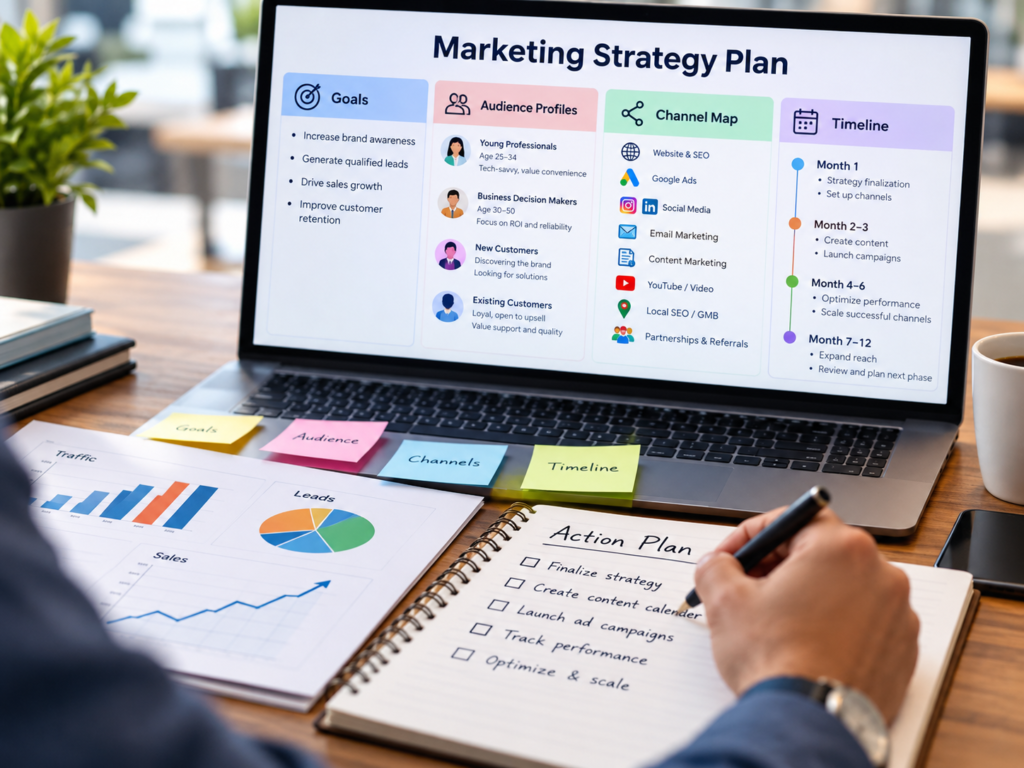
Many businesses are busy with marketing without having a marketing strategy. They post on social media, run the occasional ad, send a newsletter, update the website, and attend a trade event. Each activity makes sense on its own, but together they don’t add up to a plan. Results are hard to explain, budgets are hard to defend, and it’s unclear what to do more of.
A marketing strategy fixes that. It’s the plan that connects your business goals to your audience, your message, and the channels you’ll use to reach people. This guide explains how to develop a marketing strategy step by step, with practical questions, frameworks, and a simple template. It’s written for founders, business owners, and marketing teams who want a clear direction rather than a pile of tactics.
What Is a Marketing Strategy?
A marketing strategy is a long-term plan for how a business will reach its target customers, communicate its value, and achieve its goals. It answers a set of core questions:
- Where are we now? The market, competitors, strengths, and weaknesses
- Where do we want to go? The goals
- Who are we trying to reach? The target audience
- What do we want to be known for? The positioning and message
- How will we reach them? The channels, content, and offers
- How will we know it’s working? The measures and review process
Marketing strategy vs marketing plan vs tactics
These terms are often mixed up:
- Strategy is the overall direction and the reasoning behind it.
- Plan is the detailed schedule of what you’ll do, when, who’s responsible, and what it costs.
- Tactics are the individual actions, such as a campaign, a post, an email, or an ad.
A strategy comes first. A plan turns it into action, and tactics are the actions themselves. Without a strategy, tactics tend to become random.
Why a Marketing Strategy Matters
A marketing strategy helps you:
- Focus effort and budget on what’s most likely to work
- Stay consistent in message and look
- Make decisions faster, because there’s a reference for what fits
- Align marketing with sales and business goals
- Measure results and improve over time
- Avoid being pulled in different directions by every new trend
Step 1: Understand Your Business and Market
Start with an honest look at where you stand.
Review your business
- What do you sell, and to whom?
- What are your strongest products or services?
- What do customers say about you?
- What’s your pricing and margin position?
- Which customers are most profitable or easiest to serve?
Analyse the market
- How big and how competitive is your market?
- What trends are affecting customer behaviour?
- Are there changes in technology, regulation, or buying habits?
- Where are the gaps or unmet needs?
Use a simple SWOT
A SWOT analysis lists:
- Strengths: what you do well
- Weaknesses: where you fall short
- Opportunities: external chances you could use
- Threats: external risks or competitors
A SWOT is a thinking tool, not a magic formula. Its value lies in the honest conversation it prompts and in linking each point to a possible marketing action.
Step 2: Set Clear Marketing Goals
Marketing goals should support business goals. Start with what the business needs, then decide what marketing must achieve.
Examples of business goals:
- Grow revenue in a particular product line
- Enter a new city or segment
- Increase repeat purchases
- Launch a new product successfully
- Build a stronger brand in a crowded market
Examples of related marketing goals:
- Generate more qualified enquiries per month
- Increase website conversion rate
- Grow email subscribers
- Improve brand awareness in a target segment
- Increase customer retention
Make them specific and measurable. A useful test is the SMART approach: specific, measurable, achievable, relevant, and time-bound. For instance, “Generate 40 qualified enquiries a month within six months” gives you something to track. (Treat any numbers as illustrations, and base your targets on your own history and capacity.)
Limit the number of goals. Three or four clear priorities are easier to focus on than ten.
Step 3: Define Your Target Audience
You can’t speak to everyone effectively. Define who you’re trying to reach.
Segment your market
Group potential customers by shared characteristics, such as:
- Demographics: age, gender, income, occupation, location
- Business details (for B2B): industry, company size, role, and buying process
- Behaviour: purchase frequency, channels used, and brand loyalty
- Needs and motivations: what problem they want solved
- Values and lifestyle: what matters to them
Choose priority segments
You can’t focus on everything at once. Pick the segments that are most valuable, most reachable, and best matched to what you offer.
Build audience profiles
Create short profiles of your ideal customers, including:
- Who they are and what they do
- What they want and what worries them
- How they research and decide
- Where they spend time
- What would convince them to choose you
Base these on real data: customer conversations, sales feedback, enquiries, reviews, website analytics, and social insights.
Step 4: Analyse Your Competitors
Understand who else is competing for your customers’ attention and money.
- Direct competitors: offer the same product or service
- Indirect competitors: solve the same problem in a different way
- Alternatives: doing nothing, using a spreadsheet, or building it in-house
For each, look at:
- Their positioning and message
- Pricing and offers
- Strengths and weaknesses
- Channels they use and content they publish
- Customer reviews and complaints
Your aim isn’t to copy them. It’s to find a space where you can be clearly different and valuable.
Step 5: Define Your Positioning and Value Proposition
Positioning is how you want your customers to see you compared with alternatives. A clear value proposition explains why they should choose you.
A simple way to structure it:
- For [target customer]
- who [need or problem],
- our is [category]
- that [key benefit].
- Unlike [alternatives], we [key difference].
Then test it. Is it specific? Is it believable? Does it matter to your audience? Can competitors easily say the same thing?
Positioning is the foundation of everything that follows. A well-developed brand strategy turns your positioning, personality, and messaging into a consistent direction, and the thinking behind it also guides your visuals. We explain how strategy and identity fit together in [Brand Strategy vs Brand Identity: What’s the Difference?]
Step 6: Develop Your Brand Message and Identity
Once the positioning is clear, define how it will sound and look.
Messaging
- A core message customers should remember
- Supporting points and proof
- Tone of voice
- Key phrases and ways of explaining your offer
Visual identity
A consistent look makes marketing more recognisable and credible. This includes logo, colours, typography, imagery, and graphic style. A defined brand identity gives every campaign a foundation, and consistent graphic design assets, such as templates for social posts, presentations, and adverts, make production faster and keep everything looking like one brand.
Step 7: Choose Your Marketing Mix
The marketing mix covers the main levers you can adjust. The classic version is the “4 Ps”:
- Product: what you offer, its features, quality, and range
- Price: pricing strategy, discounts, and payment terms
- Place: where and how customers can buy, such as online, retail, or direct sales
- Promotion: how you communicate and persuade
For services, businesses often add People, Process, and Physical evidence, which cover who delivers the service, how it works, and what customers see and experience.
Review each element. Marketing isn’t only about promotion. Pricing, product design, availability, and customer experience all shape results.
Step 8: Select Channels and Tactics
Now decide how you’ll reach your audience. Choose channels based on where your audience is, what they respond to, and your resources, not on what’s fashionable.
Common channels
- Website and SEO: Your central hub, and the place where search visitors land. A well-built website through web design and development and clear UI/UX design converts attention into enquiries or sales. Online sellers may also need dependable e-commerce development.
- Content marketing: Blogs, guides, videos, and case studies that educate and build trust. A documented content strategy ties topics to goals and audience needs.
- Social media: Visibility, community, and engagement. See [How to Create an Effective Social Media Strategy] for a step-by-step approach, and consider ongoing social media marketing support if you lack capacity.
- Paid advertising: Search, social, and display ads that extend reach and drive specific results. Structured performance marketing connects spend to outcomes.
- Email and messaging: Direct communication with leads and customers.
- Video: Product demos, explainers, testimonials, and commercials. Formats such as product demo videos and creator-style UGC videos help explain and build trust.
- Partnerships and influencers: Borrowed audiences and credibility.
- Events and offline: Trade shows, local events, sponsorships, and printed material.
- Public relations and reviews: Media coverage, testimonials, and online reputation.
Match channels to the customer journey
Customers move through stages, and different channels do different jobs:
| Stage | Customer mindset | Useful channels and content |
|---|---|---|
| Awareness | “I have a need or problem” | Social media, video, search content, partnerships |
| Consideration | “What are my options?” | Website pages, guides, comparisons, demos, reviews |
| Decision | “Which one should I choose?” | Case studies, testimonials, offers, sales conversations |
| Retention | “Was it worth it?” | Email, support, loyalty offers, community |
| Advocacy | “I’ll recommend it” | Referral programmes, reviews, user-generated content |
Start with a few channels you can do well and expand once they’re working. It’s better to do three things properly than ten things badly.
Step 9: Plan Your Budget and Resources
Decide how much you’ll invest and who will do the work.
Budget
There’s no single right figure. Practical approaches include:
- Percentage of revenue: setting a share of sales for marketing
- Goal-based: working out what’s needed to reach your targets
- Competitive: considering what others in your sector invest
- Test-and-scale: starting modestly, learning, and increasing what works
Allocate budget across channels, content production, tools, and a reserve for testing and unexpected opportunities.
Resources
- Who owns the strategy and decisions?
- Who creates content and manages channels?
- What tools do you need for email, analytics, scheduling, and design?
- Which tasks will you do in-house, and which will you outsource?
Be realistic. A strategy that needs more capacity than you have won’t be carried out.
Step 10: Build an Action Plan and Timeline
Turn the strategy into a practical plan:
- Activities: campaigns, content, and projects
- Owners: who’s responsible for each
- Deadlines: key dates and milestones
- Budget: cost per activity
- Dependencies: what needs to be finished first, such as a website update before a campaign
Break it into phases, such as the first 30, 60, and 90 days, then quarterly. Include key seasonal dates, launches, and events. Plan time for testing and learning, too.
Step 11: Define Metrics and Reporting
Decide in advance how you’ll measure success. Link metrics to goals and the customer journey.
| Goal | Example metrics |
|---|---|
| Awareness | Reach, impressions, branded search, social followers |
| Engagement | Time on site, content engagement, email opens and clicks |
| Leads | Enquiries, form submissions, calls, cost per lead |
| Sales | Revenue, conversion rate, average order value, cost per acquisition |
| Retention | Repeat purchase rate, churn, customer lifetime value |
| Brand | Direct traffic, mentions, reviews, customer feedback |
Set up tracking before launching campaigns: analytics, conversion tracking, and a simple way to record where leads come from. Agree on reporting rhythm, such as weekly for campaigns and monthly or quarterly for the strategy overall.
Step 12: Launch, Test, and Refine
Strategy isn’t a document you file away. It’s a hypothesis you test.
- Launch your priority activities
- Monitor results regularly
- Run small experiments on messages, creative, audiences, and offers
- Double down on what works and stop what doesn’t
- Gather feedback from sales, customer service, and customers
- Review quarterly, checking whether goals, audience, competitors, or market conditions have changed
- Update the strategy when the evidence says you should
A Simple Marketing Strategy Template
You can summarise your strategy on one or two pages:
- Business goals and marketing goals
- Situation summary (market, competitors, SWOT highlights)
- Target audiences and priority segments
- Positioning and value proposition
- Brand message and identity guidelines
- Marketing mix summary
- Channels and tactics by customer journey stage
- Budget and resources
- Action plan and timeline
- Metrics, reporting, and review dates
Common Mistakes When Developing a Marketing Strategy
- Skipping research. Assumptions about customers and competitors are often wrong.
- Setting vague goals. “Grow the brand” can’t be measured or managed.
- Trying to reach everyone. Focus beats breadth.
- Copying competitors. It erodes differentiation.
- Confusing tactics with strategy. A list of activities isn’t a strategy.
- Spreading budget too thinly. Concentrate on fewer channels first.
- Inconsistent branding. It weakens recognition and trust.
- Ignoring the website and sales process. Marketing can’t compensate for a poor conversion path.
- Not tracking results. You can’t improve what you don’t measure.
- Treating strategy as fixed. Markets change, and plans need review.
- Neglecting existing customers. Retention and referrals are often cheaper than acquisition.
- Lack of alignment with sales and operations. Marketing promises must match delivery.
A Quick Marketing Strategy Checklist
- Business situation and market understood
- Competitors analysed
- Clear, measurable goals set
- Target audiences defined and prioritised
- Positioning and value proposition written
- Brand message and visual identity consistent
- Marketing mix reviewed
- Channels chosen and matched to the customer journey
- Budget and resources allocated
- Action plan with owners and deadlines
- Metrics and tracking set up
- Review and testing process scheduled
Final Thought
A good marketing strategy isn’t complicated. It’s clear about who you serve, what makes you different, where you’ll show up, and how you’ll know it’s working. Start with an honest view of your market and goals, choose a focused set of audiences and channels, keep your brand consistent, and review what the data tells you.
If you’d like support developing a marketing strategy, building your brand, or turning your plan into content, websites, and campaigns, talk to Akkenna.
FAQ
How do you develop a marketing strategy? Understand your business and market, set clear goals, define your target audience, analyse competitors, craft your positioning and value proposition, shape your message and identity, choose your marketing mix and channels, plan budget and resources, build an action plan, set metrics, and review regularly.
What are the key components of a marketing strategy? Goals, target audience, competitor analysis, positioning and value proposition, messaging and brand identity, marketing mix, channels and tactics, budget and resources, timeline, and metrics.
What is the difference between a marketing strategy and a marketing plan? A strategy sets the overall direction and reasoning, while a plan details the specific activities, schedule, responsibilities, and budget needed to carry it out.
How long does it take to develop a marketing strategy? It depends on the size of the business and the depth of research. A small business can create a focused strategy in a few weeks, while larger organisations may take longer.
How often should I review my marketing strategy? Review performance monthly and revisit the full strategy at least quarterly or whenever your goals, audience, competitors, or market conditions change.
How much should I spend on marketing? There’s no universal figure. Consider your goals, margins, competition, and stage of growth. Many businesses start modestly, test, and scale what works.
Do small businesses need a marketing strategy? Yes. Even a simple one-page strategy helps small businesses focus limited time and money on what matters most.
Should I hire an agency to develop my marketing strategy? It can help if you lack time, expertise, or an outside perspective. Many businesses use agencies for strategy, branding, or campaign execution while keeping day-to-day management in-house.
