How to Do Branding for a Company: A Practical Guide for Businesses in India
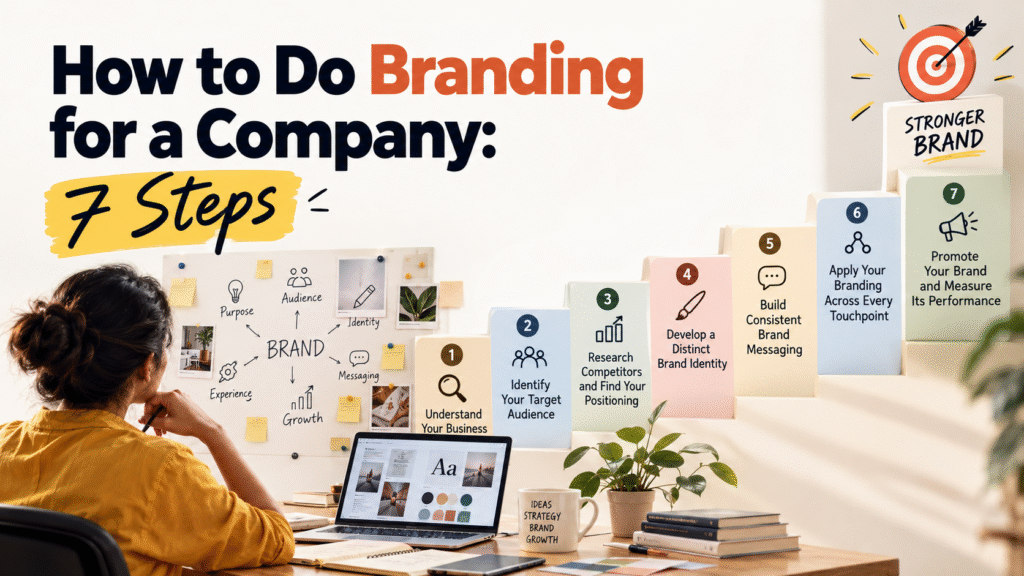
Branding is one of the most important steps in building a successful company. It helps customers recognise your business, understand what makes it different, and decide whether they can trust your products or services. However, many business owners assume branding means designing a logo, choosing colours, and creating a social media page.
In reality, effective branding involves much more. It combines business strategy, customer understanding, visual identity, communication, and customer experience to create a consistent impression of your company.
Whether you are launching a startup, expanding an established business, or repositioning your company in a competitive market, understanding how to do branding for a company can help you build a recognisable and trustworthy brand.
This guide explains the branding process step by step, with practical examples for Indian businesses.
What Does Branding Mean for a Company?
Branding is the process of defining how your company should be recognised, understood, and remembered by its target audience. It establishes your company’s identity, communicates its value, and shapes the experience customers have when interacting with your business.
A company’s brand includes several interconnected elements:
- Brand strategy: Your purpose, target audience, market positioning, and competitive advantage.
- Brand identity: Your logo, colours, typography, imagery, and other visual elements.
- Brand messaging: Your company description, tagline, tone of voice, and key marketing messages.
- Brand experience: The way customers experience your website, products, packaging, sales process, and customer service.
- Brand presence: How your company appears across digital platforms, physical locations, and marketing channels.
For example, a jewellery business in Coimbatore might differentiate itself through handcrafted designs, transparent pricing, and personalised customer service. Its branding should communicate these qualities consistently through its storefront, packaging, website, and social media content.
The objective is not simply to make your company look attractive. It is to give customers a clear reason to recognise and choose your business.
How to Do Branding for a Company: Seven Practical Steps
1. Understand Your Business Before Creating Its Brand
Start by identifying what your company stands for and what you want to achieve through branding.
Consider the following questions:
- Why was the company established?
- What problems does it solve for customers?
- What products or services does it offer?
- What makes its approach different from competitors?
- How should customers describe the company?
Your answers will establish the foundation for future branding decisions.
For instance, a healthcare company may want to communicate professionalism, accessibility, and patient care. A fashion brand may prioritise creativity, quality, and contemporary design.
Although both businesses need strong branding, their visual styles, messaging, and customer experiences will differ.
Document your company’s purpose, values, long-term goals, and key strengths before moving to the next stage. If you need a structured approach, you can develop a clear brand strategy aligned with your business objectives.
2. Identify Your Target Audience
Your brand should be designed around the people you want to attract, not simply the preferences of the business owner.
Identify your ideal customers by examining their location, needs, purchasing behaviour, budget, preferences, and reasons for choosing a particular product or service.
For a B2B company, the audience might include business owners, procurement managers, or marketing heads. For a consumer brand, it could include working professionals, young parents, or customers looking for premium products.
You can gather useful insights by:
- Speaking with existing customers.
- Reviewing customer feedback and online reviews.
- Studying frequently asked questions and sales objections.
- Analysing competitor reviews and customer expectations.
- Identifying the factors that influence purchasing decisions.
Suppose you operate a skincare brand targeting young professionals in India. Your customers may value convenient routines, clear product information, and packaging that feels modern and trustworthy.
Understanding these expectations helps you decide what your brand should communicate and how it should communicate it.
3. Research Competitors and Find Your Positioning
Once you understand your audience, study the companies competing for their attention.
Examine their websites, product presentation, messaging, pricing, visual identity, social media activity, and customer reviews.
The purpose is not to copy successful competitors. It is to identify what customers already see in the market and where your company can offer something different.
Look for answers to three questions:
- What do most competitors communicate?
- What do customers appreciate or dislike about their offerings?
- What can your company credibly do differently?
For example, if several local clothing brands focus primarily on discounts, another brand might differentiate itself through durable fabrics, transparent sourcing, and thoughtful design.
Your positioning should explain who you serve, what value you provide, and why customers should consider your company over the alternatives.
Avoid generic claims such as “best quality” or “excellent service” unless you can explain what makes those claims meaningful and demonstrate them through evidence.
A clear position makes it easier to create relevant messaging, visual identity, and marketing campaigns.
4. Develop a Distinct Brand Identity
Your brand identity translates your company’s positioning into recognisable visual and verbal elements.
This is the stage where design becomes important. However, the design should reflect the strategy established in the earlier steps rather than being developed in isolation.
A complete brand identity may include:
Logo: A recognisable symbol or wordmark that represents your company.
Colour palette: A coordinated set of colours used consistently across marketing materials and digital platforms.
Typography: Fonts that support readability and communicate the intended personality of the brand.
Imagery and graphic style: Photography, illustrations, icons, and layouts that create a consistent visual appearance.
Brand voice: Guidelines for how the company communicates, whether that means sounding professional, friendly, technical, premium, or approachable.
Your brand identity should also work across different formats, including mobile screens, business cards, packaging, presentations, advertisements, and signboards.
A logo that looks attractive on a desktop website may not work equally well on a small product label. Testing the identity across real-world applications helps prevent these problems.
You can create a consistent brand identity system that brings these elements together.
5. Build Consistent Brand Messaging
A strong visual identity helps people recognise your company, but your messaging helps them understand what you offer and why it matters.
Create a set of core messages that can be adapted for your website, advertisements, brochures, social media profiles, sales presentations, and customer communications.
Your messaging framework should establish:
- A clear company description.
- The main customer problem you solve.
- Your key value proposition.
- The benefits customers can expect.
- Evidence supporting your claims.
- A consistent tone of voice.
For example, instead of describing a packaging company only as a supplier of boxes and labels, its messaging could explain how it helps product businesses improve shelf presentation and communicate product information clearly.
The message should remain consistent while adapting to the context of each platform.
Your website may explain your services in detail, while a social media post may communicate one specific benefit. Both should reinforce the same overall brand position.
If your company publishes educational articles, case studies, and other marketing content, build a structured content strategy that supports your positioning and addresses customer questions.
6. Apply Your Branding Across Every Customer Touchpoint
Branding becomes effective when customers encounter a consistent experience, regardless of where they discover your company.
Start by listing every major point at which customers interact with your business.
| Customer touchpoint | What your branding should achieve |
|---|---|
| Website | Explain your offering and establish credibility |
| Social media | Communicate your personality and reinforce recognition |
| Packaging | Present products consistently and communicate relevant information |
| Sales materials | Explain your value proposition clearly |
| Emails and customer support | Maintain a consistent tone and professional experience |
| Physical locations | Reflect the same identity through signage and customer interactions |
| Advertising | Connect campaign messages with your overall brand positioning |
For Indian businesses, local relevance is particularly important. A company serving customers in Tamil Nadu may need to consider regional language preferences, local buying behaviour, and cultural context. A company targeting customers across India may need a more flexible communication approach.
Consistency does not mean publishing identical content everywhere. It means ensuring that every interaction feels like it comes from the same company.
Create a brand guidelines document covering logo usage, colour codes, typography, imagery, messaging, and examples of correct application. Share it with employees, designers, marketing partners, and other teams responsible for representing your brand.
7. Promote Your Brand and Measure Its Performance
Launching your brand is the beginning of the process, not the end.
Customers need repeated opportunities to discover your company, understand its value, and develop confidence in what you offer.
Choose marketing channels based on your audience and business goals. These may include search engine optimisation, social media marketing, email campaigns, content marketing, public relations, partnerships, and paid advertising.
A B2B technology company, for example, might prioritise educational content, search visibility, industry events, and case studies. A consumer product brand may focus more on visual content, creator collaborations, product demonstrations, and retail visibility.
Track your progress using relevant indicators:
- Brand awareness: How many relevant people are discovering your company?
- Branded searches: Are more people searching for your company by name?
- Audience engagement: Are people interacting meaningfully with your content?
- Customer perception: Do customers associate your company with the qualities you want to communicate?
- Lead quality: Are your marketing activities attracting suitable prospects?
- Customer retention: Are customers returning and recommending your business?
Use these indicators alongside sales and customer feedback to understand what is working. Not every change in sales can be attributed to branding alone, so evaluate brand performance using several measures rather than relying on a single metric.
For ongoing visibility and audience engagement, you can strengthen your social media marketing with content that consistently communicates your brand’s value.
How Much Does Company Branding Cost in India?
The cost of branding depends on the scope of work, the complexity of the business, the number of deliverables, and the expertise of the professionals involved.
The following are indicative planning ranges, not fixed market rates or verified quotations.
| Branding requirement | Indicative cost in India |
|---|---|
| Logo design | ₹10,000–₹75,000 |
| Complete brand identity | ₹50,000–₹3 lakh |
| Brand strategy and identity | ₹1.5 lakh–₹6 lakh |
| Comprehensive rebranding | ₹4 lakh–₹15 lakh or more |
A small business may begin with a focused brand identity project, while an established company entering new markets may need research, positioning, messaging, identity development, and a complete rollout across multiple channels.
When evaluating a branding proposal, check what is included: research, design concepts, revisions, brand guidelines, source files, packaging applications, website assets, and implementation support.
Rather than choosing a provider solely on price, compare the scope of work and how well the proposed solution addresses your business needs.
Common Branding Mistakes Companies Should Avoid
Even businesses that invest in professional design can struggle if their branding lacks direction or consistency.
Starting with a logo instead of strategy: Visual design cannot compensate for unclear positioning or an undefined target audience.
Copying competitors: Similar colours, messaging, and design choices can make your company difficult to distinguish.
Trying to appeal to everyone: A brand that communicates too broadly may fail to connect with its most valuable customers.
Changing the brand presentation frequently: Unnecessary changes to logos, colours, and messaging can weaken recognition.
Making promises the company cannot fulfil: Branding should reflect the actual quality of your products, services, and customer experience.
Treating branding as a one-time project: Markets, customers, and business objectives evolve. Your brand should be reviewed periodically while retaining the elements that customers already recognise.
Avoiding these mistakes helps you build a brand that is both visually coherent and commercially relevant.
How Long Does It Take to Brand a Company?
The timeline depends on whether you are launching a new business, refreshing an existing identity, or undertaking a comprehensive rebranding project.
A focused identity project may take a few weeks, while a broader engagement involving research, strategy, messaging, design, and implementation may take several weeks or months.
The process may also take longer when several decision-makers are involved or when the company has multiple products, locations, or customer segments.
A practical approach is to establish clear project milestones:
- Business discovery and research.
- Strategy and positioning approval.
- Brand identity and messaging development.
- Design applications and brand guidelines.
- Launch and implementation.
- Performance review and refinement.
Allow enough time for research and decision-making instead of rushing directly into design. The goal is to build a brand that supports your business over the long term.
Frequently Asked Questions
Can a small company build its own brand?
Yes. A small company can begin by defining its audience, positioning, messaging, visual identity, and customer experience. It can implement these elements gradually as its budget allows. Professional support becomes useful when the business needs specialist expertise, a more distinctive identity, or a coordinated brand strategy.
What is the difference between branding and marketing?
Branding establishes how customers should understand and remember your company. Marketing communicates your offering and attracts potential customers through channels such as search, social media, email, and advertising. Branding informs the messages and experiences that marketing delivers, while marketing helps more people discover the brand.
Should a company rebrand if its logo looks outdated?
Not necessarily. An outdated logo may require a visual refresh, but a complete rebrand should be based on broader business needs, such as a change in positioning, target audience, product offering, or market direction. Evaluate the existing brand before deciding how much needs to change.
How can a company make its brand stand out?
Start with a specific target audience, a credible point of differentiation, and a clear value proposition. Express these through distinctive messaging and visual design, then reinforce them through consistent customer experiences. Being different is useful only when that difference matters to your customers.
When should a company hire a branding agency?
Consider hiring a branding agency when launching a new company, entering a new market, repositioning an established business, managing inconsistent branding, or preparing for expansion. An agency can help align research, strategy, design, and implementation into a coherent process.
Build a Stronger Brand for Your Company
Effective company branding begins with understanding your business and customers. From defining your market position to developing your visual identity and applying it consistently across customer touchpoints, every step should reinforce the same promise.
You do not need to implement every branding activity at once. Start with the foundations, prioritise the areas that matter most to your customers, and build a consistent brand presence as your business grows.
If you want to establish a distinctive identity, communicate your value more clearly, and create a stronger foundation for marketing, Akkenna can help you plan your next steps.
Book a brand audit to discuss your company’s branding requirements and identify opportunities to strengthen your brand.
