What Makes a Brand Memorable?
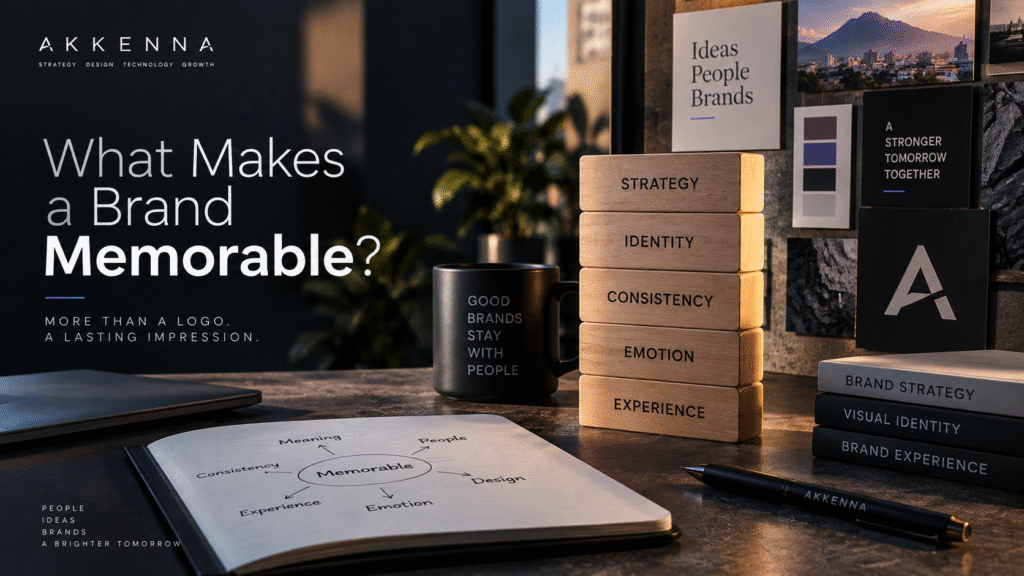
People encounter hundreds of brands every week — in social feeds, on packaging in a store aisle, in ads between videos, on hoardings on the way to work. Most leave no trace. A handful stick: you recognize them instantly, you know roughly what they stand for, and you remember how they made you feel.
The natural assumption is that this comes down to a great logo, a clever tagline, or a large ad budget. It doesn’t. Plenty of brands with attractive logos are forgotten within a week. Plenty that post daily on social media never build real recognition. Following design trends doesn’t help either — it usually just makes a brand look like everyone else chasing the same trend.
A memorable brand makes it easy for people to recognize it, understand what it stands for, and remember how it made them feel. That combination isn’t produced by any single element. It’s the outcome of positioning, identity, voice, consistency, and experience working together, repeatedly, over time.
What Does It Mean for a Brand to Be Memorable?
Brand memorability is a sequence, and businesses often optimize for the wrong stage of it.
Recognition is identifying a brand from a visual or verbal cue — a logo, a colour, a shape — without needing the name spelled out. Recall is harder: bringing a brand to mind unprompted, when a need arises, before any search even begins. Association is what both are built on — the ideas and feelings a brand has become linked to through repeated exposure. Preference is the commercial payoff, when recognition, recall, and positive association combine into a default choice.
The nuance worth holding onto: a customer can recognize a logo instantly and still have no idea what the brand stands for, or why they should choose it. Recognition without association is common — visually distinctive, strategically empty.
What Makes a Brand Memorable? 9 Key Factors
1. A Clear Brand Position
Before anything visual gets decided, a brand needs a position: who it serves, what problem it solves, what makes its approach different, and why that should matter to the customer.
Businesses trying to appeal to everyone end up standing for nothing specific in anyone’s mind. A position doesn’t need to be narrow, but it needs to be specific enough that a customer can state, in one sentence, what the brand is for. That sentence becomes the foundation everything else on this list expresses — which is why brand strategy work should come before design or messaging, not after.
2. A Distinctive Brand Identity
Brand identity is how positioning becomes visible: logo, colour palette, typography, imagery, graphic elements, layout, iconography.
A memorable identity doesn’t need to be complicated. Some of the most recognizable brands in the world use remarkably simple marks. What makes an identity work isn’t visual complexity — it’s distinctiveness relative to competitors, relevance to the positioning behind it, and consistent application everywhere it appears. A logo alone doesn’t create a memorable brand; it’s one component of a system that should reflect the strategy underneath it, which is where logo design and brand identity work connect.
3. Consistency Across Every Touchpoint
A brand’s identity only builds recognition if it looks and sounds like itself everywhere customers encounter it — website, social media, advertising, packaging, email, sales presentations, physical locations, customer service.
Inconsistency quietly erodes recognition. If a brand’s Instagram looks nothing like its website, and its sales deck uses a different tone than its email signature, customers never get enough repeated exposure to the same cues to remember them. This is the practical reason brand guidelines exist — a system that keeps a growing team and multiple channels expressing the same brand consistently, without needing constant oversight.
4. A Recognizable Brand Voice
Verbal identity carries as much weight as visual identity in memorability: tone, vocabulary, messaging style, how headlines are built, how a tagline is phrased, the shape a brand’s stories tend to take.
A useful test: could someone read a brand’s email or social caption with the logo removed and still guess whose it is? That means the brand’s language carries identity independent of visual cues — useful in audio, in conversation, anywhere the logo isn’t present.
5. Emotional Associations
Brands can become associated with trust, confidence, comfort, excitement, aspiration, belonging, reliability — and these associations often drive preference more than feature comparisons do.
Not every brand needs to chase an emotional connection as its primary strategy. A logistics company built around dependability doesn’t need manufactured excitement; a children’s brand built around imagination doesn’t need austere reliability. The association should support the brand’s actual positioning and real experience — not get bolted on because “brands need emotion.” A financial brand that consistently communicates calm competence builds trust as its association; a hospitality brand that consistently delivers warmth in small, real interactions builds belonging. In both cases, the emotion isn’t manufactured through a campaign — it’s the accumulated effect of the actual experience.
6. Distinctive Brand Assets
Distinctive assets are the specific, ownable elements a brand uses repeatedly enough that people associate them with the brand before consciously registering the logo — signature colours, visual motifs, typography, packaging shapes, characters, sounds, taglines, recurring graphic elements.
Their value comes from repetition, not novelty. A colour used once in a campaign isn’t a distinctive asset. A colour used consistently across years, across every touchpoint, becomes one — eventually able to trigger recognition without a name or logo in sight. Building these takes patience; there’s no shortcut around repeated, consistent use over time.
7. A Clear Brand Story
A brand story isn’t company history. A timeline of “founded in [year], expanded into [market]” is background information, not a reason to remember or care.
An actual brand story explains why the brand exists, what it believes, who it helps, and what’s genuinely different about its approach — often structured as problem, perspective, solution, outcome. Told well, it gives customers something more durable to remember than a feature list: a reason the brand’s existence makes sense.
8. Repetition Without Repetitiveness
Memorability requires repeated exposure. A customer might encounter a brand through a Google search, then its website, then Instagram, then an ad, then an email, then a sales conversation — several touchpoints, often across weeks.
Consistency across this journey doesn’t mean publishing identical content everywhere. It means the same underlying identity — visual system, voice, positioning, core message — shows up appropriately adapted to each channel. Repetition builds recognition; repetitiveness, the exact same asset regardless of context, tends to get ignored.
9. Delivering on the Brand Promise
Everything above concerns what a brand says and shows. This concerns what it actually does — often the difference between staying memorable for the right reasons or the wrong ones.
If a brand promises premium service, the experience needs to feel premium at delivery, not just in marketing. If it promises speed, response times need to actually be fast. If it promises personal care, customers need to genuinely experience personal attention. Brand promise leads to brand experience, and brand experience leads to brand reputation. A visually distinctive brand that fails to deliver on its promise becomes memorable for disappointment — a form of memorability no business wants.
What Doesn’t Make a Brand Memorable?
Worth being direct, since a lot of branding effort gets misspent here:
- An expensive logo
- Using lots of colours
- Posting content every single day
- A large advertising budget
- Following every current design trend
- A long, clever tagline
- Copying what competitors are doing
- The most visually complicated identity
None of these, alone, build recognition, recall, or preference. Memorability comes from distinctive, relevant, and consistently reinforced associations — not from spending or adding more.
Brand Strategy vs Brand Identity: Which Matters More?
The question sets up a false choice. Brand strategy answers who a business is, who it serves, what it stands for, and why a customer should choose it. Brand identity answers how that strategy should look and sound — the visual and verbal elements representing it consistently.
Strategy without identity has no visible form. Identity without strategy is decoration — consistent, perhaps distinctive, but disconnected from any real reason to matter. They work in sequence: strategy shapes positioning, positioning shapes identity, identity shapes experience, and experience is what builds recognition over time. See our related article, Brand Strategy vs Brand Identity: What’s the Difference?
How to Make Your Brand More Memorable
Step 1 — Define your positioning. Get specific about who you serve and what makes you different, before visual work starts. Step 2 — Identify distinctive brand cues. Decide which ownable elements you’ll commit to using repeatedly. Step 3 — Develop the identity. Build the visual system: logo, palette, typography, imagery, layout. Step 4 — Define the brand voice. Establish tone and vocabulary so the brand is recognizable in words too. Step 5 — Apply the identity consistently, using proper brand guidelines across every touchpoint. Step 6 — Strengthen the customer experience so it matches what the brand promises. Step 7 — Measure recognition and response — branded search, direct traffic, repeat customers, recall, engagement, enquiries, conversion, customer feedback. No single metric proves memorability, but a consistent trend across several is a reasonable signal.
The 5R Framework for Brand Memorability
A practical checklist we use at Akkenna — not an academic model, just a useful way to evaluate where a brand stands:
- Relevance — Does the brand matter to the audience it’s trying to reach?
- Recognition — Can people identify it quickly, from a cue alone?
- Resonance — Does it create meaningful associations, not just familiarity?
- Repetition — Are those associations reinforced consistently, over time and touchpoints?
- Reliability — Does the actual experience match what’s promised?
A brand weak on even one of these tends to underperform overall, regardless of how strong the rest are.
How Long Does It Take to Build a Memorable Brand?
There’s no universal timeline. It depends on existing awareness, competition, distinctiveness, consistency, marketing activity, customer experience, and frequency of exposure.
An important distinction: creating a brand identity can happen within a defined project — weeks to a few months of strategic and design work. Building real market recognition is different and longer — it requires continued, consistent use of that identity across real touchpoints, often over years, before recognition and recall become reliable.
When Should a Business Invest in Branding?
- Starting a new business
- Launching a new product or service
- Entering a more competitive market
- Expanding into new regions or audiences
- Repositioning after a strategic shift
- Preparing for a phase of growth
- Noticing inconsistent branding across the business
- Realizing the current brand no longer reflects what the business has become
- Preparing for a formal rebrand
None of these require unlimited budget — they’re simply points where the gap between where a brand stands and where the business needs it to stand becomes worth addressing.
Frequently Asked Questions
What makes a brand memorable? A memorable brand combines clear positioning, a distinctive identity, consistent application across every touchpoint, a recognizable voice, and a real customer experience that matches what it promises. No single element creates memorability alone — it’s the combined, repeated effect of all of them.
How can I make my brand more memorable? Start with positioning — define who you serve and what makes you different. Build a distinctive identity and voice around it, apply them consistently across every channel, and make sure the experience delivers on the promise. Memorability builds through repetition and consistency over time, not a single campaign.
Is a memorable logo enough to build a strong brand? No. A logo supports recognition, but doesn’t guarantee customers understand what a brand stands for or why to choose it. A strong brand needs positioning, consistent identity application, a recognizable voice, and an experience that reinforces what the logo represents.
What is the difference between brand recognition and brand recall? Recognition is identifying a brand from a cue you see or hear. Recall is bringing a brand to mind unprompted, with no cue present. Recall is harder to build and more commercially valuable, since it shapes whether a brand gets considered before a search even starts.
How does brand consistency improve memorability? Consistency means a brand looks and sounds the same across every touchpoint, which is what allows recognition and recall to build over time. Inconsistent branding forces customers to relearn what the brand looks like at every new encounter, slowing or preventing memorability from forming.
Does every memorable brand need a unique logo? A distinctive logo helps, but relevance and consistent application matter more than uniqueness alone. Some highly memorable brands use visually simple marks; what makes them work is consistent application tied to clear positioning, not unusual design.
How important is colour to brand recognition? Colour can become one of a brand’s most powerful distinctive assets, but only through consistent, repeated use over an extended period. A colour used inconsistently, or shared closely with competitors, contributes far less than one applied deliberately as part of a broader system.
How long does it take to build brand recognition? There’s no fixed timeline. Identity can be developed within a defined project, but market recognition builds gradually through continued, consistent exposure across real touchpoints — typically years, faster or slower depending on competition and consistency.
What is the difference between brand strategy and brand identity? Brand strategy defines who a business is, who it serves, and how it’s positioned. Brand identity is how that strategy is expressed visually and verbally. Strategy comes first and shapes identity; identity gives strategy a recognizable form customers can see and remember.
Conclusion
Memorable brands aren’t built through one isolated element — not a logo, not a tagline, not a single campaign. They’re built through clear positioning, a distinctive identity, consistent communication, recognizable brand assets, emotional associations that genuinely fit, and an experience that delivers on the promise.
The more useful question isn’t “how can we make our logo more attractive?” It’s “what do we want customers to remember about us?” That question leads to positioning. Positioning leads to identity. Identity, applied consistently and backed by real experience, leads to recognition — and recognition, sustained long enough, becomes preference.
Want a Brand People Remember?
Akkenna helps businesses develop brand strategy, identity, and digital experiences that work together — from positioning and visual identity to website design and ongoing content strategy.
